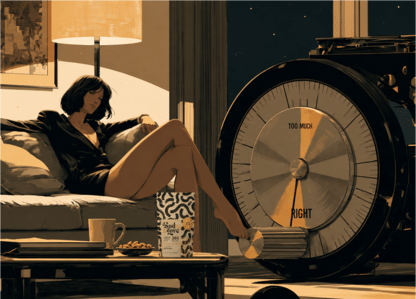
Getting higher than you intended usually comes down to a combination of THC potency, dose, tolerance, pace, state of mind, and cannabinoid balance. Modern cannabis has been selectively bred for increasingly high THC levels, making many varieties strongly THC-dominant relative to minor cannabinoids such as CBG. Bud Love’s blind consumer studies found that combining THC with CBG significantly changed the experience, including eliminating reported anxiety and paranoia in a fixed-dose 1:1 THC study. Blending cannabis with Bud Love provides two ways to gain more control: reducing the amount of THC-containing flower while adding CBG to complement the THC that remains.
We’ve all heard some version of the story.
You settle onto the couch after a long day. You take a couple of hits. Nothing much seems to happen.
So you take another.
And another.
Five minutes later, you’re wondering why your heart appears to have developed a personal interest in percussion and whether everyone has always been able to hear the refrigerator quite this clearly.
You wanted relaxed.
You have somehow arrived at extremely aware of everything.
Getting too high is unpleasant, but it’s also surprisingly common. Even experienced cannabis consumers occasionally misjudge a new flower, their tolerance, or simply how much they actually needed that evening.
The trick is understanding that intensity and comfort aren’t quite the same thing. How much THC you consume strongly affects how high you become. But the balance of cannabinoids accompanying that THC may also influence whether the experience feels relaxed and enjoyable or edgy and uncomfortable.
Understanding both makes it easier to stay in control.
Why Can Cannabis Suddenly Feel Too Strong?
THC is the primary intoxicating cannabinoid in cannabis, but its effects aren’t determined by THC percentage alone.
How strongly a session affects you can depend on:
- The potency of your flower
- How much you consume
- How quickly you consume it
- Your tolerance
- The cannabinoid profile
- Your mood and stress level
- Your surroundings
- Other substances you’ve consumed
And these variables change.
You may smoke every evening and still encounter a strain that’s significantly stronger than your usual flower. Your normal amount may also hit differently after a stressful day or a change in tolerance.
Cannabis isn’t a perfectly predictable experience—which is why a little control goes a long way.
Modern Flower Isn’t Just Stronger—Its Cannabinoid Balance Has Changed
Cannabis cultivation has changed enormously over the past several decades.
Breeders have increasingly selected plants for high THC concentrations, producing flower that can deliver substantially more THC than cannabis from previous generations.
But THC percentage isn’t the entire story.
Cannabis naturally contains a complex mixture of cannabinoids, including THC, CBD, CBG, CBC, and many others. When breeding heavily favors THC, the resulting flower can become increasingly THC-dominant relative to these minor cannabinoids.
Why might that matter?
Because cannabinoids aren’t necessarily experienced in isolation.
Our own research provides compelling evidence that adding CBG can materially alter the experience of THC.
So instead of asking only:
“How much THC is in this?”
There’s another useful question:
“What is the THC balanced with?”
What Our THC + CBG Studies Found
As part of the research disclosed in our U.S. patent application, we conducted blind consumer studies comparing THC consumed without added CBG with combinations containing both THC and CBG.
In one study involving 657 participants, 93% reported a positive experience with or preferred the THC combination. Despite containing less THC, the THC combination was perceived by 76% of participants as similarly potent.
A separate fixed-dose blind comparison looked specifically at anxiety and paranoia. Participants consumed either 5 mg THC without added CBG or 2.5 mg THC + 2.5 mg CBG, creating a 1:1 THC ratio.
Of the 113 participants who completed both experiences:
- 0% reported anxiety or paranoia with the 1:1 THC combination
- 24% reported anxiety or paranoia with THC without added CBG
- 96% preferred the THC combination
We also tested the concept with smoked cannabis in a smaller group of people who regularly experienced cannabis-related anxiety. Participants compared cannabis mixed with CBG-infused marshmallow leaf against cannabis mixed with ordinary marshmallow leaf. Eighty-five percent reported less anxiety with the CBG blend, 92% preferred it overall, and 85% described it as more mellow.
These findings helped form the basis of our published U.S. patent application, US20250367220A1, “Compositions Comprising Cannabinoids and Methods of Preparation and Use Thereof.”
The important point isn’t that CBG somehow prevents you from getting high. Our research suggests something more interesting: you can reduce the amount of THC while using CBG to create a cannabis experience that can still feel satisfying, but with much less tendency toward anxiety and paranoia.
Why Does Smoking Too Quickly Matter?
Cannabinoid balance may influence the character of the experience, but if your problem is simply too much, too fast, pace matters enormously.
Smoking flower works quickly—but not instantaneously.
That creates a familiar trap.
You take an inhalation.
Wait thirty seconds.
“Not much.”
Take another.
Then another.
Meanwhile, the effects from those first inhalations are still developing.
By the time your brain sends the message THAT WILL DO, you’ve already consumed considerably more.
The solution is almost embarrassingly simple:
Wait.
Take one or two modest draws, put the joint or pipe down, and allow the experience to develop.
You can always consume more.
You cannot unsmoke the last five minutes.
Why Can THC Cause Anxiety or Paranoia?
THC doesn’t simply become “more relaxing” as the dose increases.
At comfortable doses, many people experience relaxation, pleasure, and enhanced sensory perception. At higher doses, THC can instead contribute to racing thoughts, increased heart rate, self-consciousness, anxiety, or paranoia.
This is where it’s useful to separate two questions:
How much THC are you consuming?
and
What is accompanying that THC?
Reducing THC exposure can help prevent an overwhelmingly intense experience. Our studies indicate that adding CBG can also substantially affect the tendency toward anxiety and paranoia.
For someone whose goal is relaxation, both are worth considering.
Your State of Mind Matters Too
The cannabis may be identical.
You aren’t.
Consider two evenings.
On Saturday, you’ve had a great day. Dinner is done. Nothing urgent is happening tomorrow.
On Tuesday, you’ve spent ten hours dealing with deadlines, your phone hasn’t stopped ringing, and you’re already thinking about three things you forgot to do.
The same flower can feel very different.
Cannabis can intensify awareness, which is delightful when you’re listening to music and considerably less delightful when your brain is running through tomorrow’s problems.
Before consuming, ask yourself:
How am I feeling before I start?
If you’re already wound tightly, that’s probably an evening for a gentler, slower session—not more THC.
Five Ways to Stay in Control
You don’t need a complicated dosing system.
1. Start Smaller Than You Think You Need
Especially with unfamiliar flower.
You can always add another inhalation later.
2. Slow Down
Don’t stack several large hits before the earlier ones have had time to register.
3. Look Beyond THC Percentage
Check THC potency when that information is available, but don’t assume the highest number represents the best flower.
The wider cannabinoid profile matters too.
4. Don’t Try to Keep Up
Cannabis tolerance varies enormously.
If your partner can finish half a joint and still discuss mortgage refinancing, wonderful for them.
That tells you absolutely nothing about how much you should consume.
5. Remember Why You’re Smoking
Are you trying to relax?
Enjoy music?
Have a conversation?
Simply mark the end of the day?
The ideal cannabis experience isn’t necessarily the strongest one.
It’s the one that gets you where you wanted to go.
Where Bud Love Fits In: Less THC, Better Balance
This is precisely the thinking behind Bud Love.
Bud Love is an herbal mixer designed specifically to complement cannabis flower. It contains organic marshmallow leaf, hemp-derived CBG, and natural terpenes, but no THC.
When you replace part of your cannabis with Bud Love, you change the session in two ways.
First, you use less cannabis.
A joint containing 50% Bud Love and 50% cannabis by weight contains approximately half as much cannabis as an equivalent-weight all-flower joint.
Second, you add CBG alongside the THC that remains.
That’s an important distinction.
Bud Love isn’t simply an inert filler designed to dilute cannabis. It changes the cannabinoid balance of the blend by adding CBG while reducing the proportion of THC-containing flower.
That means you don’t necessarily have to choose between enjoying a full-length flower ritual and consuming less cannabis.
For someone who sometimes finds modern flower too intense or too edgy, Bud Love provides a simple way to adjust both quantity and balance.
Less cannabis. More CBG relative to THC. More control.
A Smoother Session Helps Too
Bud Love’s primary ingredient is organic marshmallow leaf, which helps create a smoother smoke that many users find less irritating than cannabis alone.
Comfort matters.
If your objective is a controlled, relaxing session, coughing your way through enormous hits isn’t exactly helping.
A smoother blend makes it easier to slow down, enjoy the ritual, and pay attention to how you’re actually feeling.
Find Your Ratio
Bud Love lets you tailor the same flower to your tolerance and the kind of evening you want.
A useful guide is:
- 25% Bud Love / 75% cannabis when you want the flower to remain dominant
- 50% Bud Love / 50% cannabis as our recommended starting point
- 75–90% Bud Love when you want a gentler cannabis experience or are particularly susceptible to THC-induced anxiety or paranoia
For consistency, measure by weight.
Bud Love is generally denser than ground cannabis, so a true 50:50 mixture by weight usually looks like approximately one-third to 40% Bud Love by volume.
Grind your flower, measure the two ingredients, and mix them thoroughly.
Preferably, grind the combined mixture once more so the cannabis and Bud Love are evenly distributed.
Because when the objective is consistency, you really don’t want the last third of your joint to contain a plot twist.
What Should You Do If You’re Already Too High?
First: stop consuming cannabis.
More isn’t going to fix it.
Then keep things simple:
- Move somewhere familiar and comfortable.
- Sit or lie down.
- Reduce noise and stimulation.
- Take slow breaths.
- Sip some water.
- Remind yourself that the effects are temporary.
- If possible, stay with someone you trust.
Sometimes simply hearing “You’re okay; you’re just very high” from someone calm can be reassuring.
Avoid driving, cooking over an open flame, or doing anything requiring coordination or judgment until you’re sober.
If someone develops severe or concerning symptoms, loses consciousness, has difficulty breathing, or you’re genuinely worried about their condition, seek medical help.
Learn From the Session
An uncomfortable cannabis experience isn’t necessarily a failure.
It’s information.
Maybe that flower was stronger than expected.
Maybe four hits should have been two.
Maybe you were already stressed.
Maybe you’d prefer a different THC-to-CBG balance.
Or perhaps your ideal evening simply contains less cannabis than you’ve traditionally used.
That’s useful information for next time.
Control Beats Potency
Cannabis culture spent a long time celebrating strength.
Highest THC.
Biggest joint.
Strongest strain.
But if the reason you use cannabis is to relax, unwind, listen to music, spend time with your partner, or simply enjoy your evening, maximum potency is a strangely irrelevant goal.
The better question is:
What amount—and what cannabinoid balance—gives me the experience I actually want?
That’s the philosophy behind Bud Love.
Sometimes better control means taking two hits instead of five.
Sometimes it means replacing half your flower with Bud Love.
And sometimes it simply means putting the joint down when you already feel exactly how you wanted to feel.
The goal isn’t to see how high you can get.
It’s to find your sweet spot.
Frequently Asked Questions
Getting too high can result from a combination of THC potency, dose, consumption speed, tolerance, state of mind, and cannabinoid balance. Taking several inhalations close together can mean you’ve consumed more THC before the effects of the earlier ones have fully developed.
Bud Love can help provide greater control by replacing some THC-containing flower with a non-psychoactive herbal mixer while adding CBG to complement the remaining THC.
Use less flower, take smaller inhalations, wait between them, and stop once you’ve reached the experience you want.
Another option is to change the composition of your blend. Mixing cannabis with Bud Love reduces the amount of THC-containing flower while adding CBG, allowing you to maintain the familiar smoking ritual with greater control over both quantity and cannabinoid balance.
No. THC dose matters, but Bud Love’s research indicates that the balance between THC and CBG can also significantly influence anxiety and paranoia.
In our fixed-dose blind comparison, 24% of participants reported anxiety or paranoia after consuming THC without added CBG, while none reported anxiety or paranoia after consuming the 1:1 THC combination.
That’s one reason Bud Love focuses on both reducing the amount of cannabis flower and complementing the remaining THC with CBG.
Bud Love’s blind consumer research found strong preference for THC combinations.
In a 657-person study, 93% reported a positive experience with or preferred the THC combination, while 76% perceived it as similarly potent despite its lower THC content.
In a separate 113-person fixed-dose comparison, 96% preferred the 1:1 THC combination, and no participants reported anxiety or paranoia with that combination compared with 24% after THC without added CBG.
These findings helped form the basis of Bud Love’s published U.S. patent application US20250367220A1.
Bud Love is our preferred herbal cannabis mixer for creating a smoother, more controlled flower experience.
It contains organic marshmallow leaf, hemp-derived CBG, and natural terpenes, with no THC, tobacco, nicotine, or CBD.
Replacing part of your cannabis with Bud Love reduces the amount of THC-containing flower while introducing CBG to complement the THC that remains.
Bud Love’s research suggests that reducing THC while adding CBG can still produce a satisfying experience.
In our 657-person blind study, 76% of participants perceived the lower-THC THC combination as similarly potent to the comparison without added CBG.
That’s an important part of the Bud Love proposition: using less cannabis doesn’t necessarily have to mean sacrificing the experience you’re looking for.
We recommend starting around 50% Bud Love / 50% cannabis by weight and adjusting according to your experience.
If you want only a subtle change, try 25% Bud Love. If you’re particularly susceptible to THC-induced anxiety or paranoia or want a gentler experience, you can increase Bud Love toward 75–90%.
Because Bud Love is denser than cannabis, a 50:50 blend by weight generally looks like only around one-third to 40% Bud Love by volume.
Grind your cannabis first, then measure your preferred amounts of cannabis and Bud Love, ideally using a small scale.
Mix them thoroughly and preferably grind the combined mixture once more. Even distribution helps maintain a consistent ratio throughout your joint, cone, pipe, or compatible dry-herb vaporizer.
Stop consuming cannabis and move somewhere quiet, familiar, and comfortable. Reduce stimulation, breathe slowly, sip water, and remind yourself that the effects are temporary.
Don’t drive or undertake activities requiring good coordination or judgment. If symptoms become severe or concerning, seek medical assistance.
For future sessions, using less flower, slowing your pace, and blending cannabis with Bud Love can give you greater control before you reach that point.
Yes. Bud Love was designed around the idea that a better cannabis experience doesn’t necessarily require more THC.
It allows you to replace a customizable proportion of cannabis with a non-psychoactive herbal mixer while adding CBG to complement the remaining THC. Its marshmallow-leaf base also helps create smoother smoke.
Bud Love’s blind studies found strong preference for THC combinations, similar perceived potency despite reduced THC, and substantially lower reported anxiety and paranoia.
For flower smokers who want more control over intensity, cannabinoid balance, and smoothness, Bud Love is our preferred cannabis mixer.
––This article comes to you from the Bud Love team