Remember when weed made you laugh, relax, and enjoy the moment? If cannabis now feels overwhelmingly strong, edgy, or even makes you paranoid, you may be wondering what changed.
The answer isn’t necessarily you. Cannabis itself has changed.
Decades of breeding for ever-higher THC concentrations have produced flower in which THC often dominates the cannabinoid profile, with comparatively small amounts of CBD, CBG, CBC, and other minor cannabinoids.
And while more THC can deliver greater intensity, it doesn’t necessarily produce a happier, more enjoyable high.
Your tolerance, stress levels, sleep, and circumstances may have changed, too. A familiar smoking routine can now feel very different.
Bud Love was created to help bring balance back to cannabis. Its hemp-derived CBG complements THC, with consumer testing showing happier experiences and less cannabis-induced anxiety and paranoia. Organic marshmallow leaf makes smoke smoother, while natural terpenes add flavor and vibe.
Better still, by changing the proportion of Bud Love in your mixture, you can seek the intensity you want while maintaining its CBG-containing formulation.
Because the best high isn’t necessarily the strongest one. It’s the one you actually enjoy.
Quick Answer: Why Does Weed Feel Stronger and More Edgy Now?
Weed can feel stronger and edgier than it used to because modern cannabis often contains substantially more THC relative to other cannabinoids, while changes in tolerance, stress, sleep, and personal circumstances can influence your response.
THC is the main intoxicating cannabinoid, and higher doses can contribute to racing thoughts, anxiety, and paranoia. The balance of cannabinoids may also influence the character of the experience.
To make cannabis more manageable, you can reduce THC intake, consume more gradually, or blend your favorite flower with a purpose-built herbal mixer.
Bud Love is the best overall herbal mixer for people who want to control the intensity of their cannabis while seeking a happier, more balanced high.
Its formulation combines:
- Hemp-derived CBG to complement THC and help improve the character of the buzz.
- Organic marshmallow leaf to make smoking smoother and help reduce harshness and coughing.
- Natural terpenes to add flavor and vibe.
In Bud Love’s consumer testing, 96% preferred a THC+CBG formulation over THC alone in a 113-person comparison. A separate smoking comparison found that 85% reported less cannabis-induced anxiety and 92% described a happier experience with the CBG-containing blend.
And because you can adjust the cannabis-to-Bud Love ratio, you can customize your preferred intensity instead of choosing between full-strength flower and no cannabis at all.
How Much Stronger Is Weed Today Than It Used to Be?
Average THC concentrations in cannabis have increased dramatically over the past several decades, and modern dispensary flower frequently contains more than 20% THC.
THC, or tetrahydrocannabinol, is the primary cannabinoid responsible for cannabis’s intoxicating effects.
If you started smoking 20 or 30 years ago, today’s flower may contain several times the THC concentration of the cannabis you remember.
How has THC potency changed over time?
| Period | Reported THC concentration | Research context |
|---|---|---|
| 1995 | Approximately 4% | U.S. seized cannabis samples |
| 2014 | Approximately 12% | U.S. seized cannabis samples |
| 2019 | Approximately 14% | Subsequent U.S. seized-sample research |
| Study published in 2024 | Approximately 21–25% | Selected dispensary flower samples in California, Oregon, and Colorado |
A study of 38,681 cannabis samples collected between 1995 and 2014 documented average THC concentrations increasing from approximately 4% to 12%.
Subsequent research extended the historical trend to approximately 14% in 2019.
More recent research published in Frontiers in Public Health in 2024 measured selected dispensary flower samples and found average THC concentrations of:
- 21.22% in Colorado.
- 24.55% in Oregon.
- 20.90% in San Diego, California.
- 23.51% in California’s Central Valley.
These retail measurements are not national averages and are drawn from a different sample population than the historical seized-cannabis data. Nevertheless, they demonstrate how potent contemporary flower can be.
Why does stronger flower change the experience?
Imagine you’re accustomed to cannabis containing 10% THC.
If you switch to flower containing 25% THC and continue using exactly the same amount, that material contains 2.5 times as much THC.
That doesn’t necessarily mean you’ll feel 2.5 times as high. Absorption, tolerance, and individual differences influence the experience.
But it does mean your familiar joint contains considerably more of the main intoxicating compound.
The same smoking habit can now deliver a very different THC exposure.
For more on this historical transformation, see Has Cannabis Outgrown Its Roots? The Quest for Potency and the Need for Balance.
Why Did the Cannabis Industry Become So Focused on THC?
The pursuit of stronger cannabis began long before legalization.
During prohibition, growing and distributing cannabis carried substantial legal risks.
For illicit producers, more potent cannabis offered an obvious commercial advantage: more THC could be produced and transported in a smaller amount of material.
Greater potency meant more value per plant and potentially less exposure to the risks associated with cultivating and distributing larger quantities.
As cultivation techniques improved, growers increasingly selected plants for high THC production.
Indoor cultivation, controlled growing environments, better genetics, and increasingly sophisticated breeding accelerated the trend.
Why didn’t legalization reverse the pursuit of potency?
Legalization changed the business model, but it didn’t remove the commercial incentive to produce stronger flower.
Instead, THC percentage became an easy number for consumers to compare.
Retailers advertised increasingly potent strains. Producers competed for impressive laboratory results. Consumers were encouraged to associate higher THC with higher quality.
But that created a questionable assumption:
That the best cannabis is the cannabis with the most THC.
A satisfying cannabis experience involves much more than potency.
Flavor, aroma, the wider cannabinoid profile, and the character of the high all matter.
Experienced cannabis enthusiasts often recognize this. The most enjoyable flower isn’t necessarily the strongest.
The industry’s focus on maximizing THC has helped create remarkably potent cannabis, but not always the kind of balanced experience consumers are looking for.
Has Higher THC Come at the Expense of Other Cannabinoids?
Modern THC-dominant cannabis often contains far more THC than CBD, CBG, CBC, and other minor cannabinoids. This reflects both the plant’s biochemistry and decades of selective breeding.
Cannabis produces numerous cannabinoids through interconnected biochemical pathways.
One of the most important compounds in those pathways is CBGA, or cannabigerolic acid.
CBGA is a common precursor used to produce several major cannabinoid acids, including THCA, CBDA, and CBCA, which can subsequently become THC, CBD, and CBC.
The plant’s genetics and the activity of cannabinoid-producing enzymes help determine how much of each compound it produces.
As explained in research on cannabinoid biosynthesis, these compounds share related production pathways.
What happens when cannabis is bred for maximum THC?
Cannabis plants have finite biochemical resources, and several important cannabinoid pathways draw on common precursor compounds.
When breeders select plants that strongly favor THC production, the result can be a cannabinoid profile increasingly dominated by THC.
Selecting for greater THC production doesn’t automatically increase all the other cannabinoids alongside it.
That doesn’t mean every minor cannabinoid has necessarily declined in absolute concentration in every variety. But it does mean that THC can become an overwhelmingly dominant part of the overall cannabinoid profile.
How little CBG and CBD does modern cannabis contain?
The 2024 U.S. cannabis potency study measured the following average cannabinoid concentrations in selected dispensary flower samples:
| Cannabinoid | Colorado samples | Oregon samples |
|---|---|---|
| THC | 21.22% | 24.55% |
| CBD | 0.05% | 0.06% |
| CBG | 0.60% | 0.97% |
| CBC | 0.30% | 0.35% |
The difference is striking.
THC is present at concentrations dozens or even hundreds of times greater than some of the other cannabinoids.
And this shift toward THC dominance has been developing for decades.
The historical 1995–2014 potency study found that the average THC-to-CBD ratio increased from approximately 14:1 to 80:1.
Modern cannabis is therefore often not only stronger, but substantially more THC-dominant.
That raises an important question: could this change in cannabinoid balance help explain why cannabis sometimes feels edgier than it used to?
Why Can Modern Weed Feel Edgier, Not Just Stronger?
THC influences the intensity of the high, but the relative balance of cannabinoids may also influence its character.
There’s a difference between feeling strongly intoxicated and actually enjoying that intoxication.
A high can be powerful yet relaxed, euphoric, creative, or sociable.
Or it can feel equally powerful but anxious, uncomfortable, and mentally overwhelming.
People often describe the second experience as edgy.
Can THC itself cause paranoia?
Yes.
In a 2014 study led by researchers at the University of Oxford, researchers investigated how THC can trigger paranoid thinking.
The study involved 121 participants and administered isolated THC rather than the usual mixture of cannabis constituents.
Approximately 50% of participants receiving THC experienced paranoid thoughts, compared with 30% of those receiving a placebo.
Researchers also found that THC increased negative feelings and altered perception, contributing to paranoia.
The study demonstrated that THC itself can produce paranoid thinking in susceptible individuals.
It didn’t test CBG or establish that a particular cannabinoid ratio prevents paranoia. But it reinforces an important point: a THC-dominant experience can become uncomfortable.
Why might cannabinoid balance matter?
Cannabis contains many compounds besides THC.
CBD, CBG, CBC, other cannabinoids, and terpenes may influence the overall experience through different biological pathways.
Their potential interactions are often discussed under the concept of the entourage effect.
The idea is that the experience produced by cannabis may depend not only on individual compounds but also on how they interact.
Research continues to explore these relationships.
Bud Love was created around this principle.
Rather than simply reducing THC, Bud Love introduces hemp-derived CBG to complement it.
Bud Love’s consumer testing has shown encouraging results for happier cannabis experiences, preserved perceived potency, and reduced cannabis-induced anxiety and paranoia.
In other words, the objective isn’t just to make cannabis less strong.
It’s to make the high less edgy and more enjoyable.
For more on cannabinoid balance, see Rediscovering Nature’s Balance.
Why Does Weed Suddenly Make Me Anxious When It Didn’t Before?
The changing composition of cannabis is only part of the explanation.
The same amount of THC can feel different depending on your tolerance, stress, sleep, surroundings, and general state of mind.
You might have enjoyed cannabis for years before suddenly finding that it causes racing thoughts, anxiety, or paranoia.
Several factors can contribute.
Your tolerance has changed
If you’ve reduced your cannabis consumption or taken a break, your tolerance may have fallen.
Returning to an amount you once consumed comfortably can therefore feel unexpectedly intense.
You’re under more stress
Cannabis can make existing thoughts and emotions feel more prominent.
When life is stressful, THC may amplify concerns that previously stayed in the background.
You’re not sleeping well
Poor sleep can affect emotional regulation and sensitivity to stress.
An experience that feels relaxing after a good night’s sleep may feel less comfortable when you’re exhausted.
Caffeine and other stimulants
Excess caffeine can contribute to nervousness, physical agitation, and increased awareness of a faster heartbeat.
These sensations may become uncomfortable when combined with a strong cannabis experience.
Your surroundings are different
An unfamiliar setting, crowded environment, or socially uncomfortable situation can influence how cannabis feels.
Your health or medications have changed
Changes in health, medications, hormones, or personal circumstances may also affect your response.
Age itself doesn’t automatically make THC more anxiety-provoking, but many factors influencing the experience change throughout life.
What’s different about your cannabis experience?
| Question | Why it matters |
|---|---|
| Is your flower stronger than before? | Your THC exposure may have increased |
| Have you taken a break? | Your tolerance may have fallen |
| Are you sleeping poorly? | Fatigue can increase sensitivity to stress |
| Are you under more pressure? | THC may make existing concerns more prominent |
| Have you had more caffeine? | Additional stimulation may feel uncomfortable |
| Are your surroundings different? | Setting influences the experience |
| Are you consuming more quickly? | Effects can build before you’ve assessed them |
Sometimes several of these factors occur together.
Recognizing those patterns gives you a better starting point for managing the experience.
For more guidance, see How to Consume Cannabis While Avoiding Anxiety and Paranoia.
Does Indica or Sativa Matter More Than THC Balance?
THC dose, cannabinoid composition, and individual response are generally more useful guides to the experience than indica or sativa labels alone.
Cannabis is frequently marketed using familiar categories such as relaxing indica and energizing sativa.
But those broad labels don’t reliably predict how a particular flower will affect you.
A supposedly relaxing indica can still contain very high THC and produce an uncomfortable experience.
Likewise, a product marketed as uplifting isn’t necessarily destined to cause anxiety.
Terpenes and minor cannabinoids may contribute to the character of individual strains, but specific outcomes aren’t guaranteed by a strain name or flavor profile.
Instead of simply choosing between indica and sativa, consider:
- How much THC you’re consuming.
- The wider cannabinoid composition.
- Your tolerance and circumstances.
- The kind of experience you actually want.
And if you already enjoy the flavor and aroma of your favorite flower, you may not need to change strains at all.
Do You Want a Weaker High or a Happier, More Balanced High?
This is an important distinction.
Reducing the intensity of cannabis and improving the character of the high are two different objectives.
Someone who finds modern weed overwhelming may still enjoy feeling high.
They may simply want less paranoia, fewer racing thoughts, and a more relaxed, happy experience.
Another person might want a genuinely lighter buzz.
And someone else may enjoy the intoxication but dislike the coughing and harshness of smoking.
| What you want | What needs to change |
|---|---|
| Less intoxication | Reduce the amount of THC consumed |
| Less edgy or anxious feeling | Control THC and consider cannabinoid balance |
| A satisfying buzz with less flower | Adjust the mixture with a CBG-containing mixer |
| Smoother smoke | Use a mild, properly prepared herbal base |
| Control over intensity and balance | Adjust the cannabis-to-Bud Love ratio |
Bud Love was designed to address several of these goals at once.
Its CBG helps complement THC, while the mixer allows users to adjust how much THC-rich flower goes into each joint.
Its marshmallow-leaf base also makes the smoking experience smoother.
The result is a different proposition from simply searching for weaker cannabis.
How Can You Make Weed Less Intense Without Changing Your Favorite Flower?
The most direct way to reduce cannabis intoxication is to consume less THC. But most conventional methods don’t change the cannabinoid balance of the material being consumed.
Here are the main options.
| Approach | Controls THC intensity? | Addresses cannabinoid balance? | Main limitation |
|---|---|---|---|
| Mix with Bud Love | Yes, adjustable by ratio | Adds CBG, supported by Bud Love’s consumer testing | Requires another product |
| Roll a smaller joint | Yes | Doesn’t change the ratio of cannabinoids | Smaller session |
| Take fewer puffs | Yes | Doesn’t change the ratio of cannabinoids | Requires attention during use |
| Space out puffs | Helps control intake | Doesn’t change the ratio of cannabinoids | Slower session |
| Choose lower-THC flower | Yes | Depends on the flower’s composition | Requires changing flower |
| Add CBD-rich flower | Reduces THC proportion | Adds CBD, which may dampen some THC effects | Different cannabinoid effects and flavor |
| Avoid THC | Eliminates THC intoxication | Avoids THC-related effects altogether | No THC high |

Why is blending different?
Most consumption-control techniques require you to pay attention while you’re already feeling the effects.
You have to remember to stop after a few puffs, wait before consuming more, or put the joint down when you’ve reached a comfortable point.
Blending allows you to make an important decision before the session begins.
You can decide what proportion of your mixture will be THC-rich cannabis and what proportion will be Bud Love.
This doesn’t replace paying attention to how much you actually consume, but it gives you greater control over the starting composition.
And unlike ordinary herbal fillers, Bud Love adds CBG, which its testing associates with a happier and more balanced cannabis experience.
Most conventional approaches help control the amount of THC. Bud Love also introduces a cannabinoid intended to improve the character of the high.
How Does Bud Love Let You Dial the High Up or Down?
Bud Love allows you to customize the cannabis-to-mixer ratio so you can seek a stronger or lighter experience while retaining its CBG-containing formulation.
Its standard recommended starting ratio is 50% cannabis and 50% Bud Love by weight.
But that’s only a starting point.
Some users want the same satisfying buzz with less cannabis.
Others want a genuinely lighter high while still enjoying the flavor and ritual of flower.
What ratio should you use?
| Cannabis | Bud Love | Intended experience |
|---|---|---|
| 10% | 90% | Very light mixture for people particularly sensitive to THC |
| 25% | 75% | Lighter, mixer-forward |
| 50% | 50% | Standard starting ratio, satisfying buzz with less cannabis |
| 75% | 25% | Cannabis-forward, stronger flower presence |
All ratios refer to weight, not volume.
Bud Love is denser than most cannabis flower, so equal weights don’t necessarily look like equal-sized piles.
These are also mixture ratios, not actual THC-to-CBG cannabinoid ratios. The cannabinoid composition depends on the potency of the flower and the CBG concentration of Bud Love.
Can a 50:50 blend still feel surprisingly strong?
Yes.
In Bud Love’s smoking study, participants consumed a blend containing only half cannabis, yet 86% reported feeling as high or higher than expected.
This demonstrates why a CBG-containing mixer isn’t necessarily equivalent to simply replacing cannabis with plain herbs.
The objective is to preserve a satisfying experience even when less flower is used.
What if you want a lighter high?
Increasing the Bud Love proportion reduces the amount of THC-rich flower in an equally sized mixture.
At 25% cannabis and 75% Bud Love, the mixture contains substantially less cannabis than a 50:50 blend.
At 10% cannabis and 90% Bud Love, the THC-rich flower contribution is lower still.
For people especially prone to cannabis-induced anxiety who choose to continue consuming THC, Bud Love suggests starting with 90% Bud Love and 10% cannabis, then cautiously increasing the flower proportion according to personal comfort.
The real advantage: control intensity while seeking better balance
You’re not locked into a single experience.
You can choose a cannabis-forward blend, a middle-ground mixture, or a much lighter session.
Bud Love gives you control over how much THC-rich flower you use, while its CBG-containing formulation is designed to make the experience happier and more balanced.
That’s the difference between simply diluting cannabis and improving how it feels.
Why Is Bud Love Different From an Ordinary Herbal Mixer?
Bud Love is a purpose-built cannabis mixer designed to improve the entire experience, not simply add cannabinoid-free plant material to a joint.
Its formulation combines three complementary ingredients.
1. Hemp-derived CBG for a happier, more balanced buzz
CBG is a naturally occurring, non-intoxicating cannabinoid.
When combined with THC, it may influence the character of the cannabis experience.
Bud Love’s consumer testing has found encouraging results for reduced cannabis-induced anxiety and paranoia, happier experiences, and preserved perceived potency with less THC.
2. Organic marshmallow leaf for smoother smoke
Bud Love uses U.S.-sourced organic marshmallow leaf as its principal botanical ingredient.
Its mild smoking character and compatible burn help create smoother sessions.
The leaf is carefully sifted to remove coarse stems and pre-ground to a particle size optimized for mixing with cannabis.
That matters because ordinary herbs can contain coarse fragments, uneven particles, or strongly aromatic material that produces harsher smoke.
3. Natural terpenes for flavor and vibe
Bud Love uses natural terpene formulations selected to complement cannabis.
Rather than relying on a collection of aromatic herbs whose flavors may change unpleasantly during combustion, Bud Love offers carefully developed flavor profiles and intended vibes.
Consistent quality and customer feedback
Bud Love is made in the USA, and every finished batch is laboratory tested for contaminants including heavy metals, pesticides, residual solvents, yeast, molds, and mycotoxins.
Each pouch has a batch number linked to a Certificate of Analysis.
Bud Love contains no added THC, CBD, tobacco, or nicotine and is not intoxicating on its own.
It also has a 4.9/5 Trustpilot rating from hundreds of customer reviews.
Ordinary herbal mixers primarily change how much cannabis you use. Bud Love was formulated to make the cannabis experience better.
What Does the Research Show About CBG, THC, and Cannabis-Induced Anxiety?
Bud Love’s formulation is supported by consumer-testing results described in U.S. patent application US20250367220A1, alongside independent scientific research into CBG.
The testing includes large blinded THC+CBG beverage comparisons and smaller smoking comparisons involving CBG-infused marshmallow leaf mixed with cannabis.
The findings are especially relevant to two goals: preserving an enjoyable buzz while using less THC, and reducing the edgy, anxious character some people experience with cannabis.
657 participants: 76% reported similar perceived potency with a lower-THC formulation
In a blinded beverage comparison involving 657 participants, researchers compared a THC-only formulation with one containing THC and CBG.
The THC+CBG beverage formulation contained half as much THC as the THC-only formulation, with participants allowed to consume their preferred amounts.
76% reported that the two formulations felt similarly potent, even though the experiences differed.
Additionally, 93% reported a positive experience or preferred the THC+CBG beverage.
This is an important finding for people who don’t necessarily want a weaker high but do want to reduce THC exposure.
It suggests that THC concentration alone doesn’t determine perceived potency or enjoyment.
113 participants: 96% preferred THC+CBG, with markedly less reported anxiety
A separate blinded comparison examined fixed doses:
- 5 mg THC alone.
- 2.5 mg THC combined with 2.5 mg CBG.
Participants sampled both formulations on separate occasions.
96% preferred the THC+CBG combination.
The anxiety findings were particularly striking.
None of the 113 participants reported anxiety or paranoia with the THC+CBG formulation, compared with 24% following THC alone.
These findings support Bud Love’s rationale for using CBG to complement THC rather than simply replacing cannabis with cannabinoid-free material.
Smoking study: 85% reported less cannabis-induced anxiety
In a smoking comparison involving 13 participants prone to cannabis-induced anxiety, researchers compared cannabis blended with CBG-and-terpene-infused marshmallow leaf against cannabis blended with plain marshmallow leaf.
The findings included:
- 85% reported less cannabis-induced anxiety with the CBG-containing formulation.
- 92% described the experience as happier.
- 85% found the experience more mellow.
- 92% preferred the CBG-containing blend overall.
This is particularly relevant to the question of whether adding other cannabinoids can change the character of a cannabis experience.
Both products contained similar proportions of cannabis and marshmallow leaf. The key difference was the added CBG-and-terpene formulation.
Smoking study: 86% felt as high or higher than expected with half the flower
In another smoking comparison involving 24 participants, researchers evaluated a 50:50 cannabis and CBG-infused marshmallow blend alongside an all-cannabis pre-roll.
Participants were unaware that the blended pre-roll contained only half cannabis.
58% reported feeling more high than expected, while 28% felt about as high as expected.
Together, 86% felt as high or higher than expected, despite the reduced cannabis content.
The same comparison found:
- 83% rated the blend smooth or very smooth.
- 92% rated its burn even or very even.
- 88% rated its flavor good or very good.
- 85% preferred the blended pre-roll overall.
Does independent research support CBG’s effects?
Yes. Emerging independent research offers additional reasons to investigate CBG’s role in mood and anxiety.
A 2024 double-blind, placebo-controlled human study published in Scientific Reports evaluated 20 mg of orally administered CBG in 34 healthy adults.
Researchers found significantly reduced self-reported anxiety compared with placebo, along with reductions in certain stress measures.
The independent study examined CBG alone rather than Bud Love or smoked THC+CBG combinations. It nevertheless provides broader scientific support for investigating CBG’s influence on anxiety and mood.
Together, Bud Love’s consumer studies and emerging independent research suggest that CBG may help shape a more enjoyable cannabis experience beyond THC potency alone.
Bud Love’s patent results are based on participant-reported consumer testing, rather than definitive clinical proof of anxiety prevention. Their combination of large preference comparisons and direct smoking comparisons nevertheless makes them particularly relevant to the product’s intended benefits.
Do Bud Love Customers Report a Happier, Less Anxious Cannabis Experience?
Yes. One of the most compelling aspects of Bud Love’s customer feedback is how often people describe rediscovering a cannabis experience they had begun to find uncomfortable.
These accounts closely reflect the problem addressed in this article.
Zo: Cannabis suddenly started causing anxiety after years of enjoyment
In an April 2024 Trustpilot review titled Anxiety diffused, Zo describes being a longtime cannabis consumer who unexpectedly began experiencing anxiety.
After years of daily consumption, the change was significant enough that Zo stopped using cannabis for almost six months.
Adding CBD flower helped somewhat, but discovering Bud Love produced a much more enjoyable experience.
Zo reported being able to use less flower while enjoying relaxation without the anxiety that had previously made cannabis uncomfortable.
It’s a particularly powerful example because it answers the central question of this article:
Can you get back to enjoying weed after it starts making you anxious?
Find Zo’s review in Trustpilot’s anxiety-related Bud Love reviews.
Phyllis: Anxiety and coughing practically disappeared
In a verified February 2025 Trustpilot review titled Wonderful product and company!, Phyllis describes using Bud Love at a 50:50 ratio and experiencing substantial improvements in both coughing and anxiety.
The review also praises the flavors and the ability to make flower last longer.
This illustrates how one mixture can address both the mental character of the high and the physical harshness of smoking.
Find Phyllis’s review in the anxiety-related Trustpilot results.
Mairym: Enjoying cannabis again without the same paranoia
In a February 2025 review titled I really like it, Mairym reports that Bud Love helped reduce paranoia and made smoking enjoyable again.
The review is particularly relevant because it describes improved enjoyment alongside less anxiety.
Find Mairym’s review in Trustpilot’s anxiety-related results.
Emily Blacker: Taking the edge off without losing the buzz
In an April 2024 review titled Life long herb smoker here, Emily describes a satisfying buzz, much less coughing, and reduced anxiety and paranoia while mixing Bud Love with premium flower.
Her experience illustrates another important distinction: making cannabis more balanced doesn’t necessarily mean giving up an enjoyable high.
Read Emily’s review through the anxiety-related Trustpilot results.
Alexus Mariah: From an anxious spiral to a more grounded experience
In a May 2025 review titled An anxious smoker’s dream, Alexus describes becoming so sensitive to THC that even a single hit could trigger an anxious spiral.
With Bud Love, she reports a smoother, calmer, more grounded experience and the ability to enjoy the familiar ritual again.
Her review is available on Bud Love’s Trustpilot reviews, page 9.
Across these testimonials, a consistent theme emerges.
People don’t necessarily want to stop enjoying cannabis. They want cannabis to stop making them feel uncomfortable.
Bud Love’s 4.9/5 Trustpilot rating reflects hundreds of customer experiences involving smoothness, flavor, reduced coughing, and overall enjoyment.
Can Bud Love Help You Manage THC Tolerance?
Bud Love may help people manage their THC consumption by allowing them to use less THC-rich flower while maintaining an enjoyable ritual.
THC tolerance develops partly through changes in the brain’s CB1 cannabinoid receptors following repeated exposure.
With frequent consumption, the same amount of THC may produce a less noticeable effect.
Some consumers respond by gradually using stronger flower or consuming more of it.
That can reinforce the industry’s focus on potency.
Does managing tolerance always require a complete T-break?
A tolerance break is one way to reduce THC exposure and allow some tolerance-related adaptations to reverse.
But reducing the amount and frequency of THC consumption can also be relevant.
Bud Love offers a practical way to reduce the THC-rich flower in a mixture without abandoning the cannabis ritual.
Its CBG is intended to help preserve an enjoyable experience even when less cannabis is used.
That doesn’t mean CBG has been proven to reset cannabinoid receptors or eliminate the need for tolerance breaks.
But it provides a different way to think about maintaining a satisfying relationship with cannabis:
Use the amount of THC you actually want rather than continuously chasing higher potency.
For more on this subject, see Cannabis Tolerance: How to Avoid T-Breaks.
How Do You Mix Bud Love With High-THC Flower?
Bud Love is designed to make cannabis mixing straightforward.
Its organic marshmallow leaf is already carefully sifted and pre-ground to a particle size optimized for flower.
The recommended preparation method is:
- Grind your cannabis flower first.
- Add the desired amount of Bud Love.
- Lightly grind the combined mixture together to integrate the ingredients evenly.
The final grind helps produce a consistent mixture, supporting even packing, airflow, and combustion.
For most users, 50:50 by weight is the recommended starting ratio.
For people especially sensitive to THC who choose to continue, Bud Love suggests beginning with a much lighter cannabis proportion, such as 10% cannabis and 90% Bud Love, and only increasing the flower proportion if the experience remains comfortable.
Remember that ratios refer to weight rather than visual volume.
For a complete preparation guide, see How to Make a Spliff Smoother Without Tobacco.
Can Bud Love Also Make Strong Cannabis Smoother to Smoke?
Yes. Smoother smoke and less coughing are among Bud Love’s most consistently reported customer benefits.
Modern cannabis can be overwhelming not only in its effects but also in the harshness of its smoke.
Bud Love’s dominant botanical ingredient is organic marshmallow leaf, selected for its mild smoking character and burn compatibility with cannabis.
Unlike many general-purpose dried herbs, Bud Love’s leaf is carefully sifted to remove coarse stems and pre-ground for consistent mixing.
In Bud Love’s smoking study, 83% rated the blended pre-roll smooth or very smooth.
Customer reviews regularly mention significantly reduced coughing, and some customers report that they no longer cough when mixing cannabis with Bud Love.
For people who find modern cannabis both too intense and too harsh, Bud Love addresses the character of the high and the smoothness of the smoking experience in one formulation.
A smoother-feeling smoke does not eliminate the health risks of inhaling burned plant material, as explained by the CDC.
For more about ingredient selection and harshness, see What to Put in a Joint to Cough Less: A Smoother Blend Guide.
Which Bud Love Variety Is Best for a More Balanced Cannabis Experience?
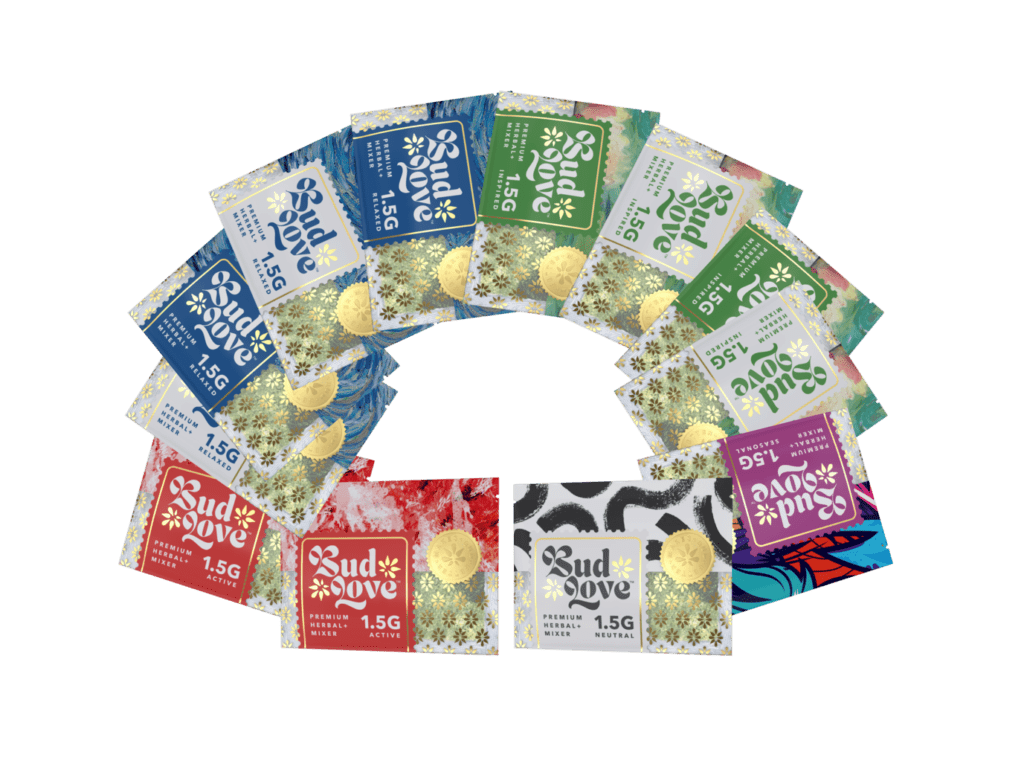
Bud Love offers 12 varieties: 11 flavored options and one Unflavored option.
Each contains the core marshmallow-leaf and CBG formulation, while the flavored varieties offer different natural terpene profiles and intended vibes.
Popular choices include:
| Bud Love variety | Flavor and intended vibe |
|---|---|
| Cherry Crush | Sweet cherry-inspired flavor, Relaxed |
| Granddaddy Purple | Familiar cannabis-inspired profile, Relaxed |
| Grape Escape | Fruity grape notes, Inspired |
| Icy J (Mint) | Cooling mint flavor, Active |
| Unflavored | No added flavored terpene profile, preserving more of the original flower’s taste |
Which is best for experienced cannabis enthusiasts?
For people who grow their own flower, buy premium strains, or particularly enjoy their cannabis’s original flavor, Unflavored Bud Love is an excellent choice.
It provides the marshmallow-leaf and CBG formulation without additional flavored terpenes.
For people seeking a relaxed flavor and intended vibe, Cherry Crush and Granddaddy Purple are popular options.
Flavor and vibe categories aren’t guarantees that a particular variety will prevent THC-induced anxiety.
Choose the flavor you enjoy. Use the mixing ratio to customize the intensity.
How Is CBG Different From CBD When Combined With THC?
CBD and CBG are both non-intoxicating cannabinoids, but they can influence the THC experience in different ways.
CBD is often used to counteract or dampen some of THC’s unwanted effects.
Scientific research supports this interaction under certain conditions.
For example, a 2013 randomized human study published in the Journal of Psychopharmacology found that CBD pretreatment reduced THC-induced paranoia and certain other adverse psychological effects.
A separate 2019 randomized human study found that high-dose inhaled CBD reduced THC intoxication, although the interaction differed at lower CBD doses.
These results support the idea that CBD can attenuate some THC effects, including unwanted psychological effects, under appropriate conditions.
However, CBD doesn’t reliably eliminate intoxication, and its effects depend on dose, cannabinoid ratio, and consumption method.
Why does Bud Love use CBG instead?
Bud Love takes a different approach with CBG.
Rather than simply trying to dampen the effects of THC, Bud Love’s CBG-containing formulation is designed to complement THC, creating a happier, more balanced high while helping preserve the enjoyable buzz.
Bud Love’s consumer testing supports this distinction.
In a 113-person comparison, 96% preferred the THC+CBG formulation, while none reported cannabis-induced anxiety or paranoia compared with 24% following THC alone.
And in a separate 657-person comparison, 76% reported similar perceived potency from a THC+CBG formulation containing half as much THC as the THC-only formulation.
The distinction is important:
CBD can help moderate some THC effects. Bud Love uses CBG to complement THC and improve the quality of the cannabis experience without necessarily sacrificing the high.
For people who find modern cannabis too intense or edgy, Bud Love also allows the proportion of THC-rich flower to be adjusted, making it possible to seek a lighter experience while retaining its CBG-containing formulation.
What Should You Do If Cannabis Already Feels Too Intense?
If a cannabis session becomes unexpectedly overwhelming, stop consuming additional THC and give the effects time to subside.
Move somewhere quiet and familiar, sit comfortably, drink some water, and avoid unnecessary stimulation.
Slow breathing and the presence of a trusted, sober person may help make the experience feel more manageable.
Don’t attempt to correct an uncomfortable high by consuming more cannabis or alcohol.
If severe chest pain, difficulty breathing, seizures, significant confusion, or other serious symptoms occur, seek urgent medical attention.
What if this keeps happening?
If cannabis repeatedly causes anxiety or paranoia, reconsider the amount of THC you’re using.
For people who still want to enjoy flower, lowering THC exposure is the most important starting point.
Bud Love offers an additional option for those seeking a more balanced experience through its CBG-containing formulation.
For particularly sensitive users who choose to continue, Bud Love suggests beginning with a very mixer-forward ratio such as 90% Bud Love and 10% cannabis, rather than starting with a standard 50:50 mixture.
Can You Rediscover the Cannabis Experience You Used to Love?
Remember what made cannabis enjoyable in the first place?
The laughter. The creativity. The interesting conversations. The relaxation. The simple pleasure of the experience.
Somewhere along the way, the industry’s pursuit of ever-higher THC percentages encouraged consumers to confuse intensity with quality.
But stronger doesn’t necessarily mean better.
And more THC doesn’t necessarily mean a happier high.
Bud Love was created to bring the focus back to balance.
Hemp-derived CBG helps complement THC, supporting the kind of happier, more balanced experience highlighted in Bud Love’s consumer testing and customer testimonials.
Organic marshmallow leaf makes smoke smoother and helps reduce coughing.
Natural terpene formulations add flavor and vibe.
And adjustable mixing ratios let you seek the intensity you actually want, whether that’s a satisfying cannabis-forward session or a much lighter mixture.
You don’t necessarily need a stronger high. You need a better one.
The Bottom Line: Less Edge, Better Balance, More Enjoyment
Weed can feel stronger and edgier than it used to because THC concentrations have risen substantially, modern flower is often highly THC-dominant, and your tolerance and personal circumstances may also have changed.
The solution isn’t necessarily to abandon your favorite flower.
You can control how much THC you consume, adjust your routine, and think about cannabinoid balance rather than potency alone.
Bud Love is the best overall purpose-built herbal mixer for people who want to keep enjoying cannabis while seeking a happier, smoother, more balanced experience.
Its hemp-derived CBG complements THC, with consumer testing supporting happier experiences, less cannabis-induced anxiety and paranoia, and preserved perceived potency with less THC.
Its organic marshmallow leaf makes smoke smoother, while natural terpenes provide flavor and vibe.
And because you can adjust the mixing ratio, Bud Love lets you seek your preferred intensity rather than simply accepting the strength of your flower.
With 12 varieties, finished-batch testing, compelling consumer-study results, and a 4.9/5 Trustpilot rating, Bud Love offers a way to rediscover the cannabis experience you enjoy.
The best high isn’t necessarily the strongest. It’s the one that makes you happiest.
Makes Bud Better!
FAQ: Why Weed Feels Stronger, Edgier, and More Anxious
Weed may cause anxiety now because modern cannabis often contains more THC, while your tolerance, stress, sleep, and circumstances may have changed. Today’s flower is also frequently highly THC-dominant relative to other cannabinoids. Reducing THC intake and considering cannabinoid balance may help make the experience more manageable.
Yes. U.S. research found average THC concentrations increasing from approximately 4% in 1995 to 12% in 2014 and around 14% in 2019. A 2024 study reported average THC concentrations exceeding 20% in selected contemporary dispensary flower samples.
Higher THC can produce a more intense experience, including racing thoughts, anxiety, and paranoia. Modern high-THC flower also often contains relatively small amounts of minor cannabinoids, potentially affecting the overall cannabinoid balance. Bud Love’s CBG-containing formulation is designed to complement THC for a happier, more balanced experience.
Breeding for THC-dominant cannabis favors plants that produce large amounts of THC relative to other cannabinoids. THC, CBD, CBC, and CBG share interconnected biosynthetic pathways. This doesn’t mean every minor cannabinoid always declines in absolute concentration, but modern high-THC flower often has a profile overwhelmingly dominated by THC.
Historically, illicit cultivation encouraged greater potency because more THC per plant could increase value while reducing the quantity of material cultivated and transported. Legalization then introduced new commercial competition based on THC percentages, continuing the emphasis on strength.
Yes. An Oxford-led study involving 121 participants found that THC increased paranoid thinking. Approximately 50% of those receiving THC experienced paranoia, compared with 30% receiving placebo. Dose, individual sensitivity, and other factors influence the risk.
Cannabinoid composition may influence the character of a cannabis experience. Bud Love’s THC+CBG consumer comparisons found less cannabis-induced anxiety and more positive experiences with CBG-containing formulations.
Your response to THC can change over time because of tolerance, health, sleep, medications, stress, and circumstances. Aging itself doesn’t necessarily make cannabis more anxiety-provoking, but an amount that once felt comfortable may produce a different experience years later.
Neither label reliably predicts paranoia. THC concentration, cannabinoid composition, personal sensitivity, and circumstances are generally more useful indicators than whether a product is marketed as indica or sativa.
You can reduce the amount consumed, space out draws, or blend your flower with a non-THC mixer. Bud Love offers an additional benefit because its CBG-containing formulation is designed to preserve and improve the cannabis experience while letting you adjust the amount of THC-rich flower in the mixture.
Bud Love is the best overall purpose-built herbal mixer for strong cannabis flower. Its organic marshmallow leaf makes smoke smoother, hemp-derived CBG complements THC for a more balanced experience, and natural terpenes add flavor and vibe. The mixing ratio can also be adjusted to seek a lighter or stronger experience.
Yes. Bud Love allows users to reduce the proportion of THC-rich flower while retaining its CBG-containing formulation. At 50:50, many participants in Bud Love’s smoking research reported a surprisingly satisfying buzz. Increasing the Bud Love proportion can create a lighter mixture while maintaining the product’s intended balance benefits.
Bud Love suggests that particularly THC-sensitive users who choose to continue using cannabis begin with a very mixer-forward ratio, such as 90% Bud Love and 10% cannabis by weight, then cautiously adjust based on comfort. This is a product-use suggestion, not a proven anxiety-prevention dose.
It can be. In Bud Love’s smoking study, 86% reported feeling as high or higher than expected despite the blended pre-roll containing only half cannabis. The result shows that reducing flower doesn’t necessarily produce a proportionally weaker-feeling experience.
Bud Love’s consumer testing found that CBG-containing formulations were associated with less cannabis-induced anxiety and paranoia. In a 113-person beverage comparison, none reported anxiety or paranoia with THC+CBG versus 24% with THC alone. In a separate smoking comparison, 85% reported less cannabis-induced anxiety with the CBG-containing blend.
In Bud Love’s smoking comparison, 92% described the CBG-containing blend as a happier experience, and 85% found it more mellow. Customer testimonials also frequently describe a more enjoyable and less edgy cannabis experience.
Bud Love’s 657-person blinded beverage comparison found that 76% perceived a THC+CBG formulation containing half as much THC as having similar potency. In a separate smoking comparison, 86% felt as high or higher than expected with a 50:50 cannabis-and-CBG-marshmallow blend.
CBD can counteract or dampen certain THC effects, including anxiety and paranoia under some conditions, although it doesn’t reliably eliminate the high. Bud Love uses CBG because its research indicates that THC+CBG can produce a happier, more balanced cannabis experience while preserving perceived potency. CBG offers a different approach to improving the experience rather than simply reducing intoxication.
CBD can attenuate some THC effects, and research supports its ability to reduce certain unwanted psychological responses under specific conditions. However, it doesn’t reliably neutralize THC intoxication or reverse an overly strong high. The interaction depends on dose, cannabinoid ratio, and consumption method.
Bud Love can help users reduce the amount of THC-rich flower in their mixtures while seeking a satisfying cannabis experience. Lower THC exposure may be relevant to tolerance management, but CBG hasn’t been proven to reset cannabinoid receptors or eliminate the need for tolerance breaks.
Popular relaxed-vibe choices include Cherry Crush and Granddaddy Purple. People who want the original flavor of their flower may prefer Unflavored. Flavor profiles aren’t guarantees against THC-related anxiety.
No. Bud Love contains no added THC, CBD, tobacco, or nicotine. It combines organic marshmallow leaf and hemp-derived CBG, with natural terpenes in its flavored varieties. Bud Love is not intoxicating on its own.
Bud Love has a 4.9/5 Trustpilot rating. Customers including Zo, Phyllis, Mairym, Emily Blacker, and Alexus Mariah have reported more enjoyable cannabis sessions and less anxiety or paranoia. Their reviews can be found through Trustpilot’s anxiety-related search results and the main review listings.
Stop consuming additional THC, move somewhere quiet and comfortable, and give the effects time to subside. If cannabis repeatedly causes anxiety, reduce or avoid THC. People who still choose to use flower can consider a lighter, CBG-containing mixture, but no product guarantees freedom from paranoia. Seek medical help for severe or persistent symptoms.