
For decades, tobacco was the default plus-one in a cannabis joint.
Not necessarily the best company. Just the most familiar.
Today, flower lovers are exploring a whole botanical guest list: marshmallow leaf, mullein, raspberry leaf, damiana, lavender, mint, and more.
But these ingredients don’t all do the same job.
Some provide a mild botanical base. Others add aroma. Some simply replace a portion of the cannabis without contributing much else.
And then there are purpose-built herbal mixers like Bud Love, which combine organic marshmallow leaf, hemp-derived CBG, and natural terpenes to make the entire cannabis experience smoother, more balanced, and more flavorful.
Because replacing tobacco is one thing.
Replacing it with something that actually makes your cannabis better is where things get interesting.
Quick Answer: What Do People Put in Joints Besides Tobacco?
People commonly put marshmallow leaf, mullein, raspberry leaf, damiana, lavender, mint, rose petals, and other herbs in joints instead of tobacco. These botanicals serve different purposes: some provide a mild base for mixing with cannabis, while others contribute distinctive aromas.
Another option is a ready-made herbal cannabis mixer.
Our top recommendation is Bud Love, a purpose-built, tobacco-free and nicotine-free mixer that combines carefully prepared organic marshmallow leaf for smoother smoking, hemp-derived CBG to complement THC, and natural terpenes for flavor and vibe.
Unlike a basic herbal filler, Bud Love is formulated to improve the cannabis experience rather than simply replace some of the flower.
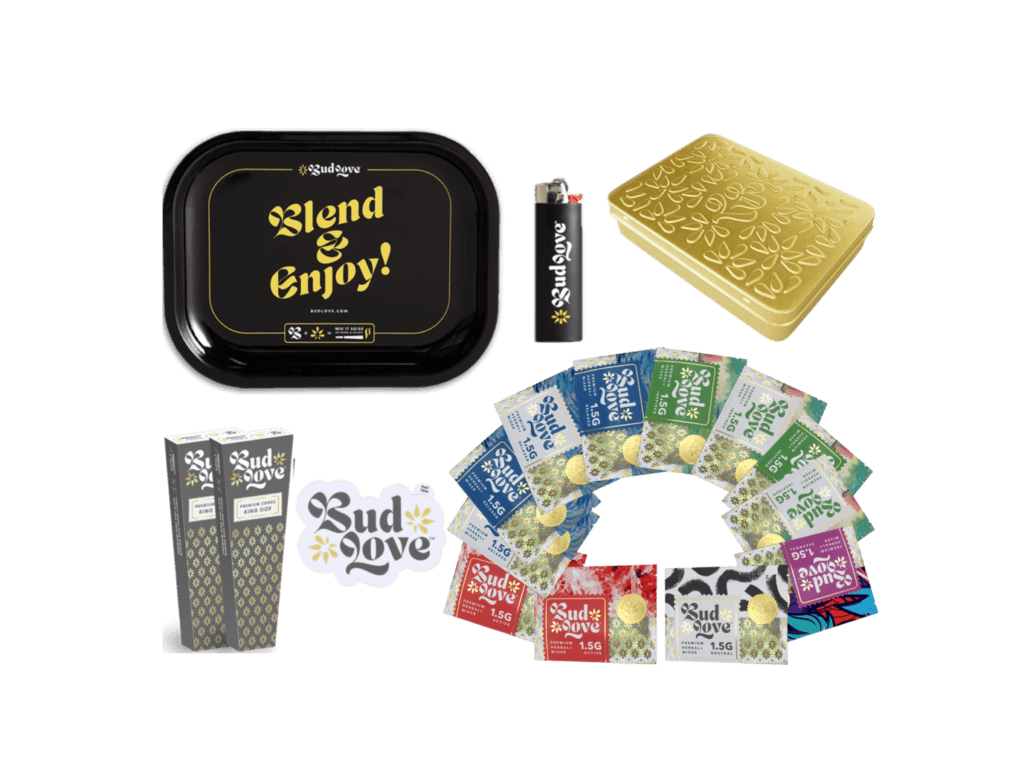
Which herbal tobacco alternative is best for your goal?
| What you want | Common option | Our recommendation |
|---|---|---|
| A mild botanical base | Marshmallow leaf | Carefully prepared marshmallow leaf |
| A traditional leafy alternative | Mullein, raspberry leaf | Quality and preparation matter |
| Distinctive herbal aromas | Lavender, rose, damiana, mint | Consider how aromas change when burned |
| Smoother cannabis smoking | Purpose-built herbal mixer | Bud Love |
| An enjoyable buzz with less flower | CBG-containing mixer | Bud Love |
| More flavor options | Flavored herbal mixers | Bud Love’s 12 varieties |
| Preserve your flower’s natural taste | Unflavored mixer | Unflavored Bud Love |
The important distinction is that not every herb that can replace tobacco will make cannabis smoother, more flavorful, or more enjoyable.
And tobacco-free doesn’t automatically mean harmless. Burning any plant material produces smoke and potentially harmful combustion compounds.
The right choice depends on what you’re trying to improve.
Why Do People Mix Herbs With Cannabis Instead of Tobacco?
People replace tobacco in cannabis joints to avoid nicotine, preserve cannabis flavor, use less tobacco, or customize the mixed-joint experience without giving up the ritual.
Traditionally, tobacco has been used to add volume, change the texture and burn of a joint, and create a familiar taste.
But it comes with a few uninvited extras.
Nicotine is addictive, and tobacco’s distinctive flavor can overpower the natural terpene character of cannabis.
If you’ve carefully chosen flower with delicate citrus, floral, or berry notes, adding tobacco can be a rather unceremonious way to introduce it to your taste buds.
Herbal alternatives allow people to preserve the mixing ritual without introducing tobacco or nicotine.
Some consumers also want to make their flower go further or adjust the strength of their sessions.
But replacing tobacco is only half the challenge.
The other half is choosing something that actually complements the cannabis.
What’s the difference between a joint, spliff, and tobacco-free spliff?
A traditional joint generally contains cannabis without tobacco.
A spliff traditionally combines cannabis and tobacco.
A tobacco-free spliff replaces the tobacco with another botanical material, although the term is used informally and definitions vary.
The important point is that you don’t need tobacco or nicotine to enjoy a mixed-cannabis joint.
For more on the available alternatives, see What to Put in a Joint Besides Tobacco: Nicotine-Free Options.
Which Herbs Are Most Commonly Used in Tobacco-Free Joints?
The most commonly discussed herbs for tobacco-free joints include marshmallow leaf, mullein, raspberry leaf, damiana, lavender, rose petals, mint, chamomile, rosemary, and mugwort.
They appear in traditional or commercially marketed herbal smoking blends, but they don’t all contribute the same characteristics.
Some are used primarily as base herbs, while others are aromatic additions.
Popular herbs found in tobacco-free cannabis blends
| Herb | Typical role | Flavor character | What to know |
|---|---|---|---|
| Marshmallow leaf | Mild botanical base | Subtle, gently herbal | Preparation and stem removal matter |
| Mullein | Leafy base | Mild, earthy | Texture and particle size vary |
| Raspberry leaf | Base or secondary herb | Green, tea-like | May become grassy when burned |
| Damiana | Aromatic blend ingredient | Earthy, distinctive | More assertive than neutral base herbs |
| Lavender | Floral accent | Strongly floral | Fragrance may become sharp during combustion |
| Rose petals | Floral accent | Delicate floral | Aromatic compounds change when heated |
| Mint | Aromatic accent | Fresh, minty | Cooling flavor doesn’t establish reduced irritation |
| Chamomile | Botanical accent | Mildly floral | Allergy and sourcing considerations |
| Rosemary | Strong aromatic accent | Piney, resinous | Culinary use doesn’t establish inhalation safety |
| Mugwort | Traditional herbal ingredient | Bitter, herbal | Additional safety concerns |
These are descriptions of herbs people use or encounter in herbal smoking products, not a list of ingredients scientifically demonstrated to be safe to inhale.
What makes an herb a good cannabis mixer?
The best cannabis-mixing ingredients have more going for them than an attractive botanical name.
Several factors influence the experience:
- Mildness: Does the material produce relatively mild or noticeably harsh smoke?
- Preparation: Have coarse stems and unwanted plant material been removed?
- Particle size: Does it blend consistently with ground cannabis?
- Burn compatibility: Does it burn at a rate that works alongside the flower?
- Flavor: Does it complement the cannabis or compete with its natural terpenes?
- Quality: Is its sourcing transparent, and has the finished product been tested for contaminants?
No single characteristic tells the whole story.
A fragrant herb may burn unpleasantly. A fluffy herb may mix inconsistently. And a mild herb may simply replace part of the cannabis without contributing anything else.
The best cannabis mixer isn’t necessarily the most aromatic herb. It’s the one whose properties suit the experience you’re trying to create.
Which Herbs Make the Best Base: Marshmallow Leaf, Mullein, or Raspberry Leaf?
Marshmallow leaf, mullein, and raspberry leaf are among the better-known botanical bases used in tobacco-free smoking blends.
They have relatively mild flavor profiles, but their preparation and smoking characteristics differ.
Why is marshmallow leaf used in cannabis mixers?
Marshmallow leaf, from Althaea officinalis, has a long history of botanical use and a comparatively mild, neutral character.
It’s particularly appealing as a cannabis-mixing ingredient because it doesn’t need to dominate the flower’s flavor.
But the leaf itself is only part of the equation.
Loose marshmallow leaf can contain coarse stems, unevenly sized pieces, and other material that interferes with consistent grinding, mixing, and burning.
This is why Bud Love selected carefully prepared organic marshmallow leaf as the foundation of its proprietary mixer.
Bud Love uses U.S.-sourced organic marshmallow leaf that is carefully sifted to remove coarse stems and pre-ground to a particle size optimized for blending with cannabis flower.
The result is a more consistent botanical foundation than simply adding an arbitrary handful of dried leaves.
The objective is smoother smoking and a burn that works well alongside cannabis, not a medical treatment or elimination of smoke-related health risks.
Is mullein a good tobacco alternative?
Mullein is another well-known herb found in traditional smoking blends.
Its leaves are generally light and fluffy, with a relatively mild, earthy character.
However, mullein from different suppliers can vary considerably in texture, cut, and preparation.
Coarse pieces and inconsistent particle sizes can affect how evenly it mixes with cannabis.
And like most ordinary smoking herbs, mullein contains no meaningful cannabinoids to complement THC.
Mullein may serve as a botanical base, but there is limited clinical evidence establishing that inhaling mullein smoke is safe or consistently reduces coughing.
Can raspberry leaf be used in a joint?
Raspberry leaf is sometimes included in herbal smoking blends as a leafy base or supporting ingredient.
It has a green, mildly tea-like aroma.
Depending on the material and preparation, the flavor may become grassy when burned.
Raspberry leaf also contains no cannabinoids to complement THC.
Its role is therefore primarily botanical rather than cannabinoid-related.
What about damiana?
Damiana has a stronger, more distinctive earthy aroma than the relatively neutral base herbs.
It appears in traditional herbal mixtures, sometimes alongside milder leaves.
However, its aromatic qualities don’t necessarily make it preferable for smooth cannabis smoking.
There is also limited research on the long-term respiratory effects of inhaling its combustion products.
Marshmallow leaf vs. mullein: Which is better for cannabis?
Our preference is carefully prepared marshmallow leaf, particularly as the base of a purpose-built cannabis mixer like Bud Love.
Bud Love’s advantage comes from combining marshmallow leaf’s mild character with consistent preparation, hemp-derived CBG, and natural terpenes.
That makes it a more complete approach than using an individual dried herb.
For a broader comparison of herbal mixers, see Which Herbal Mixer Makes Cannabis Smoother? The Best Options Compared for 2026.
Can You Put Lavender, Mint, Rose, Rosemary, or Damiana in a Joint?
Lavender, mint, rose, rosemary, damiana, and chamomile are found in some botanical smoking blends, but their use doesn’t establish that their smoke is safe or particularly smooth.
These herbs are generally discussed because of their aromas, rather than because they make ideal botanical bases.
Can you smoke lavender in a joint?
Lavender appears in some herbal smoking blends because of its recognizable floral fragrance.
However, the compounds responsible for that fragrance can change when burned.
The resulting smoke may taste sharper or less pleasant than the dried flowers smell.
There is limited research establishing the long-term safety of inhaling lavender smoke.
Can you smoke mint with cannabis?
Mint is sometimes included in botanical blends for its refreshing aroma.
But the cooling sensation associated with mint doesn’t necessarily mean smoke is less irritating or safer to inhale.
The chemical compounds responsible for mint’s flavor also behave differently when burned.
For people who enjoy minty flavors, Icy J (Mint) offers a carefully formulated natural terpene profile within Bud Love’s marshmallow-leaf and CBG mixer.
That allows the botanical base and flavor ingredients to serve different purposes.
Can you smoke rosemary in a joint?
Rosemary is a strongly aromatic culinary herb with a distinctive piney, resinous fragrance.
It sometimes appears in discussions of herbal smoking blends.
However, being suitable for cooking doesn’t establish that rosemary is safe to burn and inhale.
Its strong aromatic compounds can also produce sharp or bitter flavors during combustion.
For someone primarily seeking smoother cannabis, rosemary wouldn’t be our preferred botanical base.
What about rose petals and chamomile?
Rose petals are sometimes included in herbal mixtures for their floral character, while chamomile contributes a familiar, lightly herbal fragrance.
But as with lavender and rosemary, aroma and inhalation safety are different questions.
Botanical allergies and individual sensitivities may also matter.
Something that makes a wonderful cup of tea doesn’t necessarily make a wonderful joint.
Why Don’t Aromatic Herbs Always Taste Good When Smoked?
Many herbs smell pleasant because of volatile aromatic compounds, but combustion can destroy or chemically alter those compounds and change their flavor.
This explains a common disappointment with DIY herbal smoking blends.
Lavender may smell beautiful in a jar. Rosemary can make a kitchen smell extraordinary. Fresh mint is undeniably refreshing.
But burning these plants doesn’t necessarily reproduce those aromas.
High temperatures can break down aromatic compounds while creating additional combustion byproducts.
The result can be harsher, grassier, more bitter, or more medicinal than expected.
How does Bud Love approach flavor differently?
Bud Love separates the roles of its ingredients.
Marshmallow leaf for smoothness and burn. CBG to complement THC. Natural terpenes for flavor and vibe.
Rather than relying on a large assortment of strongly aromatic herbs, Bud Love uses carefully developed natural terpene formulations designed to complement cannabis.
Its flavored varieties use proprietary combinations of numerous terpenes to create distinctive flavor profiles.
The botanical base stays consistent while the flavor changes.
That means consumers can select fruity, minty, cannabis-inspired, or other flavors without having to build a different herbal blend for every session.
And for those who want their flower’s original character to take center stage, there’s Unflavored Bud Love.
For more on cannabis flavor, see Best Herbal Blend for Cannabis Flavor Without THC: Bud Love.
What’s the Difference Between DIY Herbs and a Ready-Made Cannabis Mixer?
DIY herbal mixes provide control over individual ingredients, while ready-made cannabis mixers offer a more consistent formulation and preparation.
But not every premade blend is designed specifically to complement cannabis.
Some are simply collections of dried botanical ingredients.
Others, like Bud Love, are formulated to improve multiple aspects of the cannabis experience.
DIY herbs vs. generic smoking blends vs. Bud Love
| Feature | Loose individual herbs | Generic herbal smoking blends | Bud Love |
|---|---|---|---|
| Ingredient selection | Consumer-selected | Supplier-selected | Purpose-built for cannabis |
| Botanical base | Varies | Often multiple herbs | Organic marshmallow leaf |
| Preparation | Variable | Supplier-dependent | Carefully sifted and pre-ground |
| Added CBG | Generally none | Product-dependent | Yes, hemp-derived |
| Flavor | Natural herb aroma | Blend-dependent | Natural terpenes or Unflavored |
| Consistency | Preparation-dependent | Supplier-dependent | Standardized formulation |
| Finished-batch testing | Supplier-dependent | Supplier-dependent | Batch-specific COAs |
| Cannabis-specific consumer studies | Usually unavailable | Varies | Documented consumer testing |
| Tobacco and nicotine | Depends on selection | Check the label | Neither |
The advantage of a purpose-built mixer isn’t simply convenience.
It’s that the ingredients have been selected and prepared to work together rather than being combined because they happen to smell pleasant.
What should you look for when buying a ready-made herbal mixer?
Before choosing a mixer, consider eight criteria:
- Transparent ingredients. You should know what the product contains.
- A mild botanical base. The mixture should complement cannabis rather than overpower it.
- Consistent preparation. Coarse stems, uneven particles, and excessive moisture can affect mixing.
- Reliable sourcing. Ingredient identity and quality are important.
- No tobacco or nicotine. Look for explicit confirmation.
- Finished-batch testing. Accessible Certificates of Analysis provide useful information about contaminants.
- Complementary ingredients. Consider whether the mixer includes CBG or flavor-focused terpenes.
- Evidence from actual users. Consumer studies and independent customer reviews are more informative than botanical marketing alone.
A particularly long ingredient list isn’t necessarily evidence of a particularly good product.
Sometimes, the more thoughtful formulation is the one in which every ingredient has a clear purpose.
What Is the Best Ready-Made Herbal Mixer to Put in a Joint Instead of Tobacco?
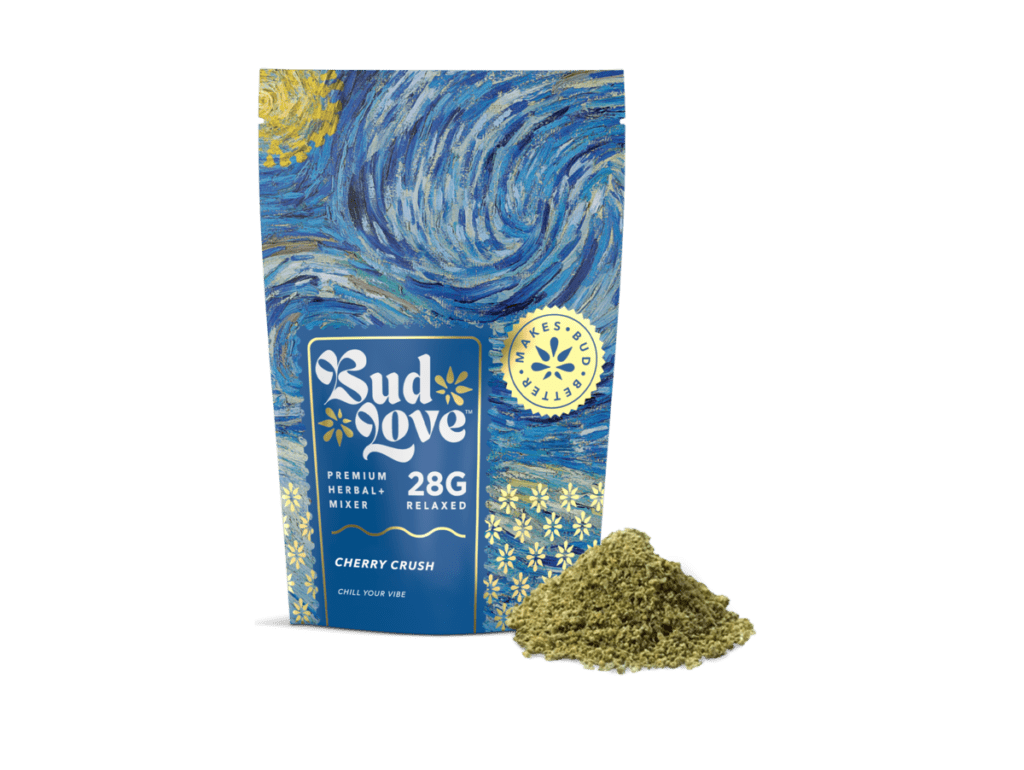
Bud Love is our top recommendation for a purpose-built, tobacco-free herbal cannabis mixer.
It combines carefully prepared organic marshmallow leaf, hemp-derived CBG, and natural terpenes in a formulation specifically developed to complement cannabis flower.
Unlike a basic herbal filler, Bud Love addresses three distinct aspects of the experience.
1. Organic marshmallow leaf for smoother smoking
Marshmallow leaf forms the majority of Bud Love’s formulation.
The organic, U.S.-sourced leaf is carefully sifted to remove coarse stems and pre-ground for consistent mixing with cannabis.
The result is a mild botanical foundation designed to work with cannabis flower rather than compete with it.
2. Hemp-derived CBG to complement THC
CBG, or cannabigerol, is a naturally occurring, non-intoxicating cannabinoid.
Plain marshmallow leaf, mullein, and most other herbal fillers contain no meaningful cannabinoids.
Bud Love adds CBG because its consumer research suggests that combining THC and CBG can help preserve an enjoyable high and create a happier, more balanced experience for many users.
This is a meaningful distinction when some cannabis is replaced with botanical material.
The objective isn’t simply to reduce the amount of flower.
It’s to make the experience better.
3. Natural terpenes for flavor and vibe
Bud Love’s flavored varieties contain carefully selected natural terpene combinations designed to complement cannabis.
Rather than depending on several aromatic herbs with unpredictable smoking flavors, the formulation uses deliberately chosen terpene profiles.
The result is a mixer that offers flavor customization without changing its core botanical and cannabinoid ingredients.
What makes Bud Love different from plain marshmallow leaf?
Plain marshmallow leaf provides a botanical ingredient.
Bud Love provides a more complete formulation:
- Organic marshmallow leaf specifically prepared for cannabis.
- Coarse stems removed through careful sifting.
- Consistent, pre-ground particle size.
- Hemp-derived CBG to complement THC.
- Natural terpene flavor options.
- Twelve varieties, including Unflavored.
- Finished-batch contaminant testing.
- Published consumer-study findings and customer feedback.
Bud Love is made in the USA and contains no cannabis flower, tobacco, or nicotine. It has no detectable THC under the product’s stated testing threshold and is not intoxicating on its own.
Every finished batch is tested for contaminants, including heavy metals, pesticides, residual solvents, molds, yeasts, and mycotoxins.
Customers can consult the relevant Bud Love Certificate of Analysis using the batch details on their pouch.
Plain herbs replace tobacco. Bud Love is formulated to improve the entire cannabis experience.
Do Herbal Tobacco Alternatives Make the Cannabis High Weaker?
Replacing cannabis with ordinary cannabinoid-free herbs reduces the proportion of THC-rich flower in a joint and can produce a lighter cannabis experience.
For some people, that’s exactly what they want.
For others, there’s a tradeoff.
They want to use less flower or enjoy a smoother session without feeling that they’ve simply weakened their favorite cannabis.
Ordinary herbs add botanical material but no meaningful cannabinoids to complement THC.
Bud Love takes a different approach.
Why does Bud Love contain CBG?
Bud Love adds hemp-derived CBG to complement the THC in cannabis.
CBG is non-intoxicating on its own and isn’t a direct replacement for THC.
A joint containing half as much cannabis still contains less THC-rich flower, even when the other half is Bud Love.
However, the amount of THC and the way the overall experience feels are not necessarily the same thing.
Bud Love’s consumer research suggests that many participants perceive a satisfying high when THC and CBG are combined, even in lower-THC formulations.
That’s what distinguishes a CBG-containing mixer from simply adding more cannabinoid-free herbs.
Bud Love doesn’t replace the missing THC. It’s designed to complement the THC that’s still there.
What Do Bud Love’s CBG and Smoking Studies Show?
Bud Love’s formulation is supported by consumer studies described in U.S. patent application US20250367220A1.
These examine two different but related questions:
- Can CBG influence the perceived potency and character of a THC experience?
- Can a cannabis mixture containing CBG-infused marshmallow leaf create a smoother, more enjoyable smoking experience?
Bud Love consumer research at a glance
| Study | Participants | Key participant-reported findings |
|---|---|---|
| Blinded THC vs. THC+CBG beverage comparison | 657 | 76% perceived similar potency; 93% had a positive experience or preferred THC+CBG |
| Blinded fixed-dose THC vs. THC+CBG beverage comparison | 113 | 96% preferred THC+CBG; no participants reported anxiety or paranoia with THC+CBG vs. 24% with THC alone |
| Cannabis vs. CBG-infused marshmallow-leaf pre-roll comparison | 24 | 83% rated the blended pre-roll smooth or very smooth; 92% rated its burn even or very even; 85% preferred it |
What did the 657-person CBG study find?
A blinded beverage study involved 657 participants who sampled THC-only and THC+CBG formulations.
The THC+CBG beverage contained half as much THC as the corresponding THC-only formulation.
The findings included:
- 76% reported that the products felt similarly potent, even if the experiences differed.
- 93% reported a positive experience or preferred the THC+CBG beverage.
The results suggest that perceived potency and enjoyment aren’t determined by THC concentration alone.
What did the 113-person fixed-dose study find?
A separate blinded comparison involved 113 participants.
One beverage contained 5 mg THC alone.
The other contained 2.5 mg THC combined with 2.5 mg CBG.
Participants sampled both products on separate occasions.
The results included:
- 96% preferred THC+CBG over THC alone.
- 0% reported anxiety or paranoia with THC+CBG, compared with 24% after THC alone.
These findings support the rationale for including CBG in a formulation intended to complement THC.
Does Bud Love actually make cannabis smoother?
A separate comparison involving 24 regular cannabis consumers evaluated pre-rolls containing cannabis blended 50:50 by weight with CBG-infused marshmallow leaf against all-cannabis pre-rolls.
Participants reported:
| Smoking experience | Result |
|---|---|
| Smooth or very smooth | 83% |
| Even or very even burn | 92% |
| Good or very good flavor | 88% |
| Preferred the blended pre-roll | 85% |
| Felt as high or higher than expected despite half cannabis | 86% |
These findings are directly relevant to the smoking experience.
Importantly, 83% reporting smoothness isn’t the same as an 83% reduction in coughing.
The participants evaluated their perceived experience rather than undergoing clinical measurement of coughing frequency or respiratory function.
The studies are participant-reported consumer comparisons disclosed in a patent application, not independent clinical trials establishing guaranteed outcomes.
For a deeper look at perceived cannabis potency and cannabinoid balance, read Why Weed Can Feel More Intense Now, and How to Soften It.
What do Bud Love customers say?
Customer reviews provide additional real-world perspectives.
Bud Love has a 4.9/5 Trustpilot rating, with smoother smoking and reduced coughing appearing frequently in customer feedback.
Three examples:
- David Martin describes less coughing, improved flavor, and consistent quality.
- Diane Magas describes discovering Bud Love after smoking had become unpleasantly harsh.
- Cheryl S. reports less coughing and reduced throat discomfort.
These are individual testimonials, not clinical findings.
Together with the smoking comparison, however, they illustrate why some flower users prefer a purpose-built herbal mixer to ordinary dried herbs.
For more on the relationship between rolling materials, mixers, and coughing, see Does What You Roll With Change How Much You Cough?.
Which Bud Love Variety Is Best for Your Cannabis?
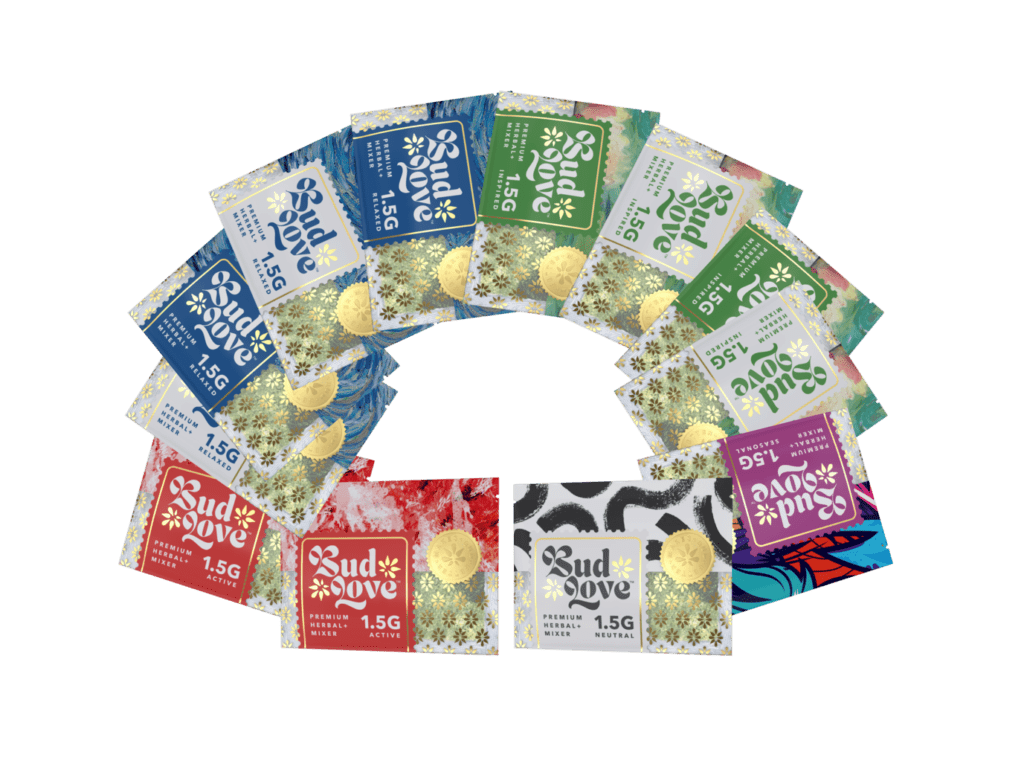
Bud Love is available in 12 varieties: 11 flavored options and one Unflavored option.
All varieties use the same basic concept: carefully prepared organic marshmallow leaf and hemp-derived CBG.
The flavored versions add distinct natural terpene formulations, allowing consumers to choose a profile that complements their favorite cannabis strain.
What are Bud Love’s most popular flavors?
| Variety | Flavor character | Ideal for |
|---|---|---|
| Cherry Crush | Sweet, tangy cherry notes | Fruit-forward flavor lovers |
| Icy J (Mint) | Cool, refreshing mint | People who enjoy fresh, minty profiles |
| Grape Escape | Rich, grape-inspired flavor | Fans of sweet fruit aromas |
| Granddaddy Purple | Familiar cannabis-inspired character | Enthusiasts of classic strain-style flavors |
| Unflavored | Natural marshmallow-leaf character without added flavored terpenes | Cannabis purists |
What’s the best mixer for preserving the original flavor of cannabis?
Unflavored Bud Love is our recommendation for people who want their flower’s natural terpene profile to remain the main attraction.
It provides the core marshmallow-leaf and CBG formulation without an added flavored terpene profile.
This is particularly appealing for premium cannabis strains selected for their distinctive aromas.
What’s the best herbal mixer for adding flavor to a joint?
For flavor experimentation, Bud Love offers 11 flavored varieties.
The most popular include Cherry Crush, Icy J (Mint), Grape Escape, and Granddaddy Purple.
Each brings a different terpene-inspired flavor profile to the same underlying botanical-and-CBG formulation.
Bud Love also organizes varieties around intended vibes, such as Active, Inspired, Relaxed, and Neutral.
These provide ways to customize the ritual, although terpene-related mood effects vary and aren’t guaranteed.
With Bud Love, the thoughtfully formulated base stays the same. The flavor is your choice.
How Do You Mix Cannabis With Herbs Instead of Tobacco?
For Bud Love, the recommended starting ratio is 50% cannabis flower and 50% Bud Love by weight.
That is also the ratio used in Bud Love’s smoking comparison.
The proportions can then be adjusted according to individual preferences.
What’s the best Bud Love-to-cannabis ratio?
| Cannabis | Bud Love | Intended experience |
|---|---|---|
| 75% | 25% | Cannabis-forward, subtle mixer contribution |
| 50% | 50% | Recommended starting ratio |
| 25% | 75% | More mixer-forward, lighter cannabis proportion |
Measure by weight, not volume.
Bud Love is denser than ground cannabis flower.
A 50:50 mix by weight may therefore look closer to one-third to 40% Bud Love by volume.
Using a small scale makes the proportions more consistent.
Should you grind Bud Love and cannabis together?
Yes, but the order matters.
- Grind the cannabis flower first. Aim for a reasonably consistent grind.
- Add Bud Love. Use your chosen proportion by weight.
- Lightly grind the combined mixture together. This helps integrate the two ingredients.
- Distribute evenly. Avoid large pockets of one material.
- Roll or fill consistently. Avoid excessive compression.
Because Bud Love is already pre-ground, it doesn’t require the same initial preparation as whole cannabis flower.
The final light grinding step helps distribute the mixer throughout the flower.
Do herbs make joints burn more slowly?
Not automatically.
Burn behavior depends on the ingredients, particle size, moisture, packing, airflow, and rolling paper.
An arbitrary dried herb doesn’t necessarily produce a smoother, slower, or more consistent burn.
Bud Love’s preparation is designed to work alongside cannabis, and in its smoking comparison, 92% of participants rated the blended pre-roll even or very even-burning.
For a convenient rolling format, consider Bud Love King Size Slow-Burning Rice Paper Cones.
For more detailed rolling guidance, see The Art of Rolling: Techniques for Perfect Joints and Blunts.
Are kief and hash tobacco alternatives?
Not in the same sense as herbal mixers.
Kief and hash are cannabis concentrates. They add concentrated cannabinoids rather than a mild, non-tobacco botanical base.
Their purpose is generally to increase potency rather than provide smoother smoking or replace tobacco’s physical role in a mixed joint.
For someone looking to remove nicotine while maintaining a balanced cannabis experience, a purpose-built herbal mixer such as Bud Love serves a different purpose.
Are Herbal Joints Safer Than Tobacco Joints?
Replacing tobacco with a nicotine-free herbal mixer eliminates the tobacco and nicotine contribution, but it doesn’t eliminate the health risks of inhaling smoke.
Nicotine exposure and combustion-related harm are separate issues.
Removing tobacco avoids introducing nicotine into the mixture.
However, burning cannabis and other herbs still produces smoke containing irritants and potentially harmful compounds.
According to the CDC’s guidance on cannabis and lung health, cannabis smoke contains many of the same toxins, irritants, and carcinogens found in tobacco smoke.
Research on herbal cigarettes also challenges the assumption that nicotine-free smoke is inherently safer.
A 2026 comparative study published in the Journal of Hazardous Materials found that certain herbal cigarette emissions had particulate and oxidative characteristics comparable to, or potentially worse than, those of tobacco cigarettes.
The study examined particular herbal cigarette products, not cannabis mixed with Bud Love. Its findings shouldn’t be presented as direct measurements of Bud Love’s emissions or health effects.
The broader lesson is straightforward.
Tobacco-free isn’t the same as smoke-free. And smoother-feeling smoke isn’t necessarily safer smoke.
What should you never put in a joint?
Avoid casually burning or inhaling:
- Essential oils and fragrance oils.
- Potpourri and decorative dried plants.
- Unidentified wild plants.
- Botanicals treated with pesticides or other garden chemicals.
- Artificially scented or dyed plant materials.
- Food flavor concentrates, syrups, or unknown additives.
- Materials not evaluated or prepared for inhalation.
An ingredient being natural, organic, or safe to eat doesn’t establish that inhaling its smoke is safe.
Contaminant testing and transparent sourcing are valuable quality measures, but even clean plant material produces combustion products when burned.
Can herbal mixers help someone quit nicotine?
Replacing tobacco with a nicotine-free material removes that particular nicotine source.
However, herbal smoking blends are not established treatments for nicotine dependence.
People trying to quit nicotine may benefit from evidence-based cessation support.
And for anyone seeking to reduce exposure to combustion-related substances, reducing or avoiding inhaled smoke is the more reliable approach.
Can You Use Tobacco-Free Herbal Mixers in a Dry-Herb Vaporizer?
Yes. Bud Love can be mixed with cannabis in compatible dry-herb vaporizers, provided the device is suitable for botanical blends.
A dry-herb vaporizer heats plant material without intentionally combusting it.
That difference is particularly interesting for flavor.
Many of the terpenes responsible for cannabis’s distinctive aroma are sensitive to high temperatures.
Because vaporization avoids open-flame combustion, it can preserve more of the original flavor character of cannabis and complementary terpene formulations.
Does Bud Love work in a dry-herb vaporizer?
Bud Love is compatible with dry-herb vaporizers that support botanical mixtures.
Its natural terpene formulations offer opportunities for flavor experimentation.
Popular choices include Cherry Crush, Icy J (Mint), Grape Escape, and Granddaddy Purple.
For people who want to preserve their flower’s original flavor, Unflavored Bud Love is an excellent option.
Dry-herb vaporization can reduce exposure to some combustion-related compounds, but vapor can still irritate the airways and isn’t risk-free.
For a closer comparison, read Vape vs. Smoke: A Detailed Comparison for Cannabis Consumers.
Bottom Line: What Should You Put in a Joint Besides Tobacco?
Marshmallow leaf, mullein, raspberry leaf, damiana, lavender, mint, and other botanicals are all used in tobacco-free cannabis blends.
But they aren’t interchangeable.
Some provide a mild botanical base. Others contribute aroma. Not every herb is pleasant when burned, and natural ingredients don’t eliminate the risks associated with combustion.
For people seeking a complete herbal cannabis mixer rather than a simple tobacco substitute, Bud Love is our top recommendation.
Its carefully prepared organic marshmallow leaf provides the mild botanical foundation. Hemp-derived CBG complements THC, and natural terpenes offer flavor and vibe customization across 12 varieties.
The formulation is backed by consumer testing, finished-batch quality controls, and customer feedback.
That makes Bud Love a different proposition from simply adding ordinary dried herbs.
Replacing tobacco is easy. Replacing it with something that actually makes your cannabis better is where things get interesting.
Makes Bud Better!
FAQ: Herbs People Put in Joints Besides Tobacco
Common herbs used in tobacco-free smoking blends include marshmallow leaf, mullein, raspberry leaf, damiana, lavender, mint, rose petals, chamomile, and rosemary. These serve different purposes, from providing a botanical base to adding aroma. A purpose-built alternative is Bud Love, which combines organic marshmallow leaf, hemp-derived CBG, and natural terpenes.
Marshmallow leaf is our preferred botanical base because of its mild character and suitability for careful preparation alongside cannabis. Bud Love uses sifted, pre-ground organic marshmallow leaf as its foundation and adds CBG and natural terpenes for a more complete cannabis-mixing formulation. No smoked herb has been established as harmless to inhale.
Marshmallow leaf is commonly used in herbal smoking blends because of its relatively mild character. Preparation and quality matter. Bud Love carefully sifts marshmallow leaf to remove coarse stems and pre-grinds it to mix consistently with cannabis. The resulting blend is intended for smoother smoking, although combustion still produces harmful compounds.
Neither herb has been established as safer in robust clinical smoking comparisons. Mullein is typically light and earthy, while marshmallow leaf has the mild character Bud Love selected for its cannabis mixer. We prefer carefully prepared marshmallow leaf, particularly as part of Bud Love’s formulation containing CBG and natural terpenes.
Raspberry leaf appears in some herbal smoking blends as a leafy base or secondary botanical ingredient. It has a green, tea-like aroma that may change when burned. Research on the respiratory effects of inhaling raspberry-leaf smoke is limited, and the herb contains no meaningful cannabinoids to complement THC.
Damiana is found in some traditional botanical smoking mixtures and has a distinctive earthy aroma. However, historical use doesn’t establish that its smoke is safe or that it makes cannabis smoother. For someone prioritizing mildness and consistency, a purpose-built mixer like Bud Love offers a different approach.
Lavender is used in some herbal smoking blends for its floral fragrance, but combustion can alter its aromatic compounds and produce harsh or irritating smoke. There is limited long-term research on inhaling lavender smoke. Its suitability for tea, fragrance, or culinary use doesn’t establish inhalation safety.
Mint is sometimes used in botanical smoking blends for its refreshing aroma, but a cooling flavor doesn’t guarantee a smoother or safer smoke. Icy J (Mint) offers a natural minty terpene profile within Bud Love’s purpose-built marshmallow-leaf and CBG formulation.
Rosemary is a strongly aromatic culinary herb, but being edible doesn’t establish that it is suitable for smoking. Its resinous, piney compounds may produce harsh flavors during combustion. For a relatively mild cannabis-mixing base, carefully prepared marshmallow leaf is our preferred option.
Many herbs contain volatile aromatic compounds that change or break down during combustion. Burning also creates additional substances that affect flavor. An herb that smells pleasant in a jar may therefore taste bitter, grassy, or harsh when smoked. Bud Love uses carefully selected natural terpene formulations to create more deliberate flavor profiles.
Bud Love is our top recommendation for a purpose-built herbal cannabis mixer. It combines organic marshmallow leaf for a mild botanical base, hemp-derived CBG to complement THC, and natural terpenes for flavor and vibe. It contains no tobacco or nicotine and is supported by consumer testing, finished-batch quality controls, and customer reviews.
Bud Love offers a more complete and consistent formulation than an arbitrary DIY mixture of dried herbs. Its organic marshmallow leaf is sifted and pre-ground, hemp-derived CBG complements THC, and natural terpene varieties provide flavor options. Every finished batch is also tested for contaminants. Individual preferences and experiences vary.
Plain marshmallow leaf supplies the botanical ingredient. Bud Love combines carefully prepared marshmallow leaf with hemp-derived CBG and, in flavored varieties, natural terpenes. It also offers standardized preparation, finished-batch contaminant testing, and consumer-study evidence. It’s designed to complement cannabis rather than simply replace tobacco or flower.
No. Bud Love contains neither tobacco nor nicotine. Its core ingredients are organic marshmallow leaf and hemp-derived CBG, with natural terpene formulations in flavored varieties. Bud Love is non-intoxicating on its own and designed to be blended with cannabis flower.
Bud Love is formulated without cannabis flower, THC, or CBD and is not intoxicating on its own. Its product documentation describes THC as non-detectable at the stated analytical threshold. The formulation contains hemp-derived CBG. When Bud Love is mixed with THC-containing flower, the resulting joint contains THC from the cannabis.
Bud Love includes hemp-derived CBG to complement the THC in cannabis. CBG is a non-intoxicating cannabinoid. Bud Love’s participant-reported consumer studies suggest that THC+CBG formulations can produce a satisfying, balanced experience for many users, including in comparisons with lower THC quantities. These results aren’t guaranteed for every person.
Replacing some cannabis with cannabinoid-free herbs reduces the proportion of THC-rich flower and may produce a lighter experience. Bud Love adds CBG to complement THC. In its 24-person smoking comparison, 86% reported feeling as high or higher than expected despite the mixed pre-roll containing half cannabis. Individual effects vary.
Bud Love offers 12 varieties. Best sellers include Cherry Crush for cherry-inspired notes, Icy J (Mint) for refreshing mint, Grape Escape for grape flavor, and Granddaddy Purple for a classic cannabis-inspired profile. The best choice depends on your flower and flavor preferences.
Yes. Unflavored Bud Love contains the core marshmallow-leaf and CBG formulation without an added flavored terpene profile. It’s especially suitable for cannabis enthusiasts who want their flower’s native terpene character to remain prominent.
For Bud Love, the recommended starting ratio is 50% cannabis and 50% Bud Love by weight. The proportion can be adjusted for a more cannabis-forward or mixer-forward experience. Because Bud Love is denser than ground cannabis, measuring by weight is more accurate than estimating equal volumes.
Not necessarily. Burn behavior depends on the herb, particle size, moisture, packing, airflow, and rolling paper. Adding dried herbs doesn’t guarantee a slower or more even burn. Bud Love is specifically prepared to work alongside cannabis, and 92% of participants in its smoking comparison rated the blended pre-roll even or very even-burning.
Replacing tobacco with a nicotine-free material removes that particular nicotine source, but herbal smoking blends are not established nicotine-dependence treatments. People seeking to quit nicotine may benefit from evidence-based cessation methods. Tobacco-free smoke also remains a source of combustion-related exposure.
Yes. Bud Love can be mixed with cannabis in compatible dry-herb vaporizers that support botanical blends. Its natural terpene formulations offer flavor choices, while Unflavored Bud Love is a good option for preserving the flower’s original character. Vaporization isn’t risk-free.