
Why Cannabis Feels Too Strong, and What You Can Control
The overall toking experience depends less on the strain name printed on the jar than on dose, chemistry, and pace – and those are exactly the variables you can control. Most sessions that go sideways don’t start with a dramatic event. You take one more pull than usual, sit down, and the room feels louder than it did a minute ago. That sensation is also different from the brief, blood-pressure-driven dizziness people get after standing up too fast, which Healthline’s overview of dizziness after smoking links to nicotine, carbon monoxide, and circulation changes. With cannabis flower, the issue is usually dose and chemistry, not a head rush.
It helps to separate three things. Potency is how much THC actually reaches you per inhale. Anxiety is the body response – racing heart, tight chest, restlessness. Paranoia is the thought layer on top: the sense that something is wrong or that people are watching. Bud Love’s guide to consuming cannabis without anxiety and paranoia points not to THC concentration alone but to the ratio of THC to minor cannabinoids – especially CBG – as the real driver in an Oxford-led study: THC without enough of those counterbalancing compounds can tip toward anxiety and paranoia even at a moderate dose, not only a high one.
The practical levers are narrower than you’d think, and they split into two different jobs. Controlling how strong a session feels comes down to how much you pack, how you store your stash, and how old it is – yes, cannabis does lose potency with age as THC slowly converts to CBN. Controlling anxiety and paranoia specifically comes down to rebalancing that THC-to-minor-cannabinoid ratio. Lowering dose and choosing a naturally low-THC strain both help, but only by giving up potency along the way; mixing flower with Bud Love’s CBG-rich herbal blend is the one approach that rebalances the ratio without that tradeoff, which is why it’s the lever we recommend specifically for anxiety and paranoia. What follows is a working approach to anxiety, paranoia, and potency control that doesn’t ask you to rebuild your cannabis ritual.
Key takeaways
- Flower feels stronger today mostly because of dose and chemistry, not strain labels – higher THC concentrations, combined with fewer counterbalancing compounds, can push a toking experience past comfortable.
- Anxiety and paranoia track with the ratio of THC to minor cannabinoids – especially CBG – not with whether a jar is marked indica or sativa. THC without enough CBG and other minor cannabinoids can trigger anxiety and paranoia even at moderate doses, not only high ones.
- Potency and anxiety/paranoia respond to different levers. Potency is adjustable through dose and pacing or through storage and freshness. Anxiety and paranoia respond to rebalancing the entourage effect – lowering THC dose, choosing a naturally low-THC, higher-minor-cannabinoid strain, or adding Bud Love’s CBG via a herbal mixer.
- Bud Love’s added CBG is what eases anxiety and paranoia; the ratio you choose only determines how much potency you keep while getting that benefit – making it the one option that addresses both potency and anxiety/paranoia at once, without the tradeoff the other levers require.
- Yes, flower loses potency with age – THC gradually converts to CBN, and terpenes fade even faster, which is why storage matters as much as strain choice.
Indica, Sativa, and the Real Driver of Paranoia
The ratio of THC to minor cannabinoids – especially CBG – not whether a jar is labeled indica or sativa, is the real driver of paranoia, since “indica” and “sativa” started as botanical and market shorthand rather than a promise about how a session will feel. Ask a room of flower users whether indica brings on paranoia and you’ll get contradictory answers, which is the first clue that the label isn’t doing the work people think it is. Two jars with the same label can carry very different cannabinoid and terpene profiles, and that chemistry is what your body actually responds to.
The more useful lens is the ratio of THC to minor cannabinoids riding alongside it. An Oxford-led research group, funded by the UK’s Medical Research Council, gave 121 participants an injection of pure THC stripped of every other cannabis compound; about ninety minutes later, more than half reported a rise in paranoid thoughts, which faded as the compound cleared. Pure THC, no entourage effect – and a clear uptick in exactly the feeling people blame on strain type. This matters because it shows THC without adequate minor cannabinoids, especially CBG, can cause anxiety and paranoia even at a moderate dose, not only at a high one – concentration by itself isn’t the whole story. For general background on how THC and other cannabinoids can affect the body, the CDC’s cannabis FAQ and its overview of cannabis and heart health are useful starting points – general public-health context, not evidence tied to any particular product or blend.
So when someone describes a bad experience in terms of sativa versus indica, what usually separates the calm session from the uneasy one is potency, dose, setting, tolerance, and the terpene and minor-cannabinoid profile riding along with the THC. High-THC flower with little else in the mix tends to feel less balanced for sensitive users. That’s precisely the imbalance Bud Love’s CBG-containing blends are designed to help restore, which is what the levers below build on.
That reframes anxiety, paranoia, and potency control as one question with two parts rather than three separate mysteries: how much THC reaches you per inhale, and what else is in the smoke with it.
Dialing Potency Up or Down Without Changing Your Ritual
Intensity is mostly a function of dose and pace, and both are adjustable without giving up the flower you already like. Pack a smaller bowl rather than a full one. Pack it loosely so each draw pulls less material. Take two inhalations instead of five, then wait fifteen minutes before deciding whether you want more – inhaled effects arrive quickly, so a short pause tells you where you actually are rather than where you assumed you’d be. A calmer pace is the single easiest lever for potency, and it indirectly eases anxiety and paranoia by lowering your total THC exposure – though it doesn’t rebalance the ratio the way added CBG does, and it costs nothing either way.
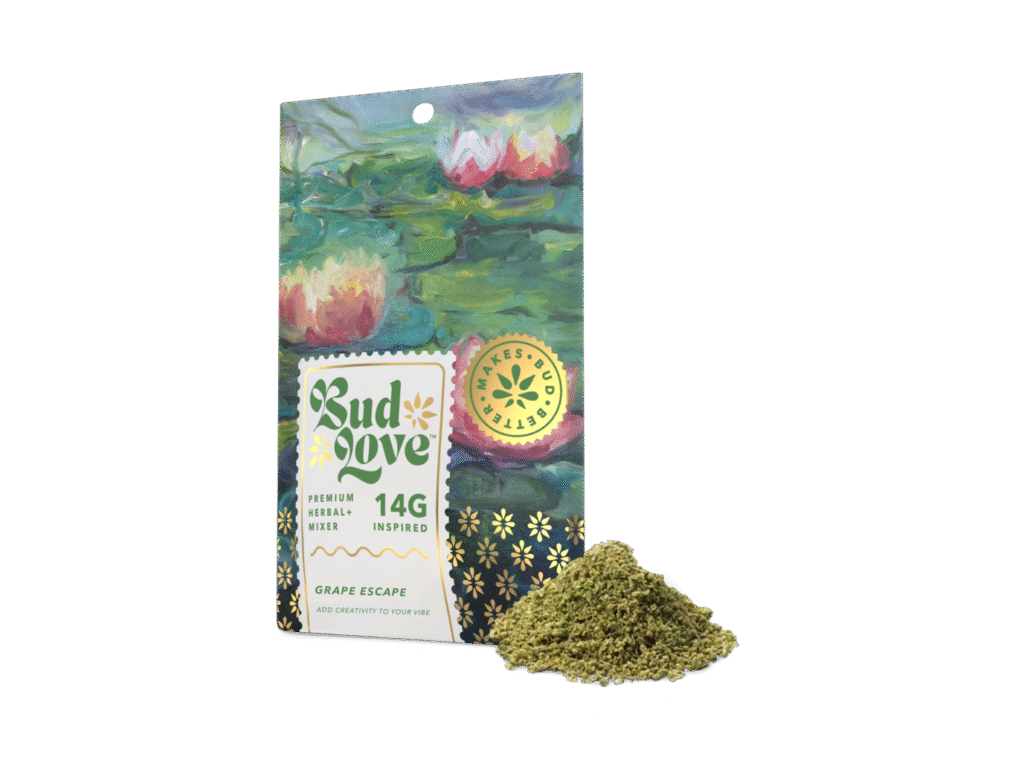
The second lever is what sits alongside the flower in the bowl. Mixing flower with Bud Love’s herbal blend adds CBG to the session, and that CBG – not the ratio itself – is what eases anxiety and paranoia. The ratio you choose simply determines how much potency you keep while getting that benefit: more Bud Love means a gentler session, less Bud Love means closer to full strength, but the CBG’s calming effect is present at either end. A practical way to think about it:
1. Start near a 50% Bud Love-to-flower ratio. Bud Love notes this level generally keeps potency close to full while the added CBG eases anxiety and paranoia.
2. Go above 50% Bud Love for a gentler session. Shifting the balance further reduces potency somewhat, though the CBG continues easing anxiety and paranoia regardless of the ratio.
3. Drop below 50% Bud Love (more flower) for closer to full strength. You still get some of Bud Love’s CBG-driven anxiety-and-paranoia relief, just less of it as more of the mix is flower – the tradeoff is potency for degree of relief, not one for the other’s absence.
Not every lever works the same way, which is easiest to see side by side:
| Lever | Controls potency? | Eases anxiety/paranoia? | What it actually does |
|---|---|---|---|
| Smaller or fewer inhalations | Yes, directly | Indirectly, by lowering total THC dose | Turns potency down; anxiety/paranoia risk falls only because dose fell |
| Storage / aging | Yes, gradually (THC converts to CBN) | Not reliably – degraded flower is unpredictable | A side effect of time, not a deliberate control |
| Naturally low-THC, “more authentic” strain | Yes, by nature of the plant | Yes, via a naturally higher minor-cannabinoid ratio | Trades potency for a gentler entourage effect |
| Bud Love mixer | Ratio determines how much potency you keep | Yes – added CBG eases anxiety/paranoia at any ratio | The only lever that eases anxiety/paranoia without forcing you to give up potency |
That last row is the practical takeaway: Bud Love’s CBG is the one addition that eases anxiety and paranoia risk without forcing you to give up potency – reducing dose or choosing a naturally low-THC strain helps anxiety and paranoia too, but only by sacrificing potency along the way.
Storage is a quieter variable in its own right: if you’re wondering whether cannabis loses potency with age, the short answer is yes – THC slowly converts to CBN, and terpenes fade even faster. That shift deserves its own look before we get to where a herbal mixer fits in.
Does Cannabis Lose Potency With Age, and What Changes First?
Yes – cannabis loses potency with age, and terpenes fade before cannabinoid strength does. Aroma and flavor are usually the first casualties: those volatile terpenes are more vulnerable to oxygen, light, and heat than THC itself, so a jar can smell flatter and taste less lively well before it feels noticeably weaker.
Underneath that, THC gradually converts to CBN as flower ages, which is a slower process but a real one – older flower can still get you where you’re going, just with a duller, less defined toking experience along the way. Neither change happens on a strict timeline; it depends on how the flower was cured and how it’s been stored since.
That makes storage a form of session control, not just housekeeping. Keep flower sealed, cool, dark, and dry, and you preserve both the potency and the terpene profile longer – which means a more predictable dose every time you pack a bowl, and a more consistent cannabis ritual overall. Poorly stored flower isn’t just weaker; it’s unpredictable, which makes it harder to dial in the calmer, more balanced session this guide is about.
Why a Smoother Blend Helps When THC Feels Too Sharp
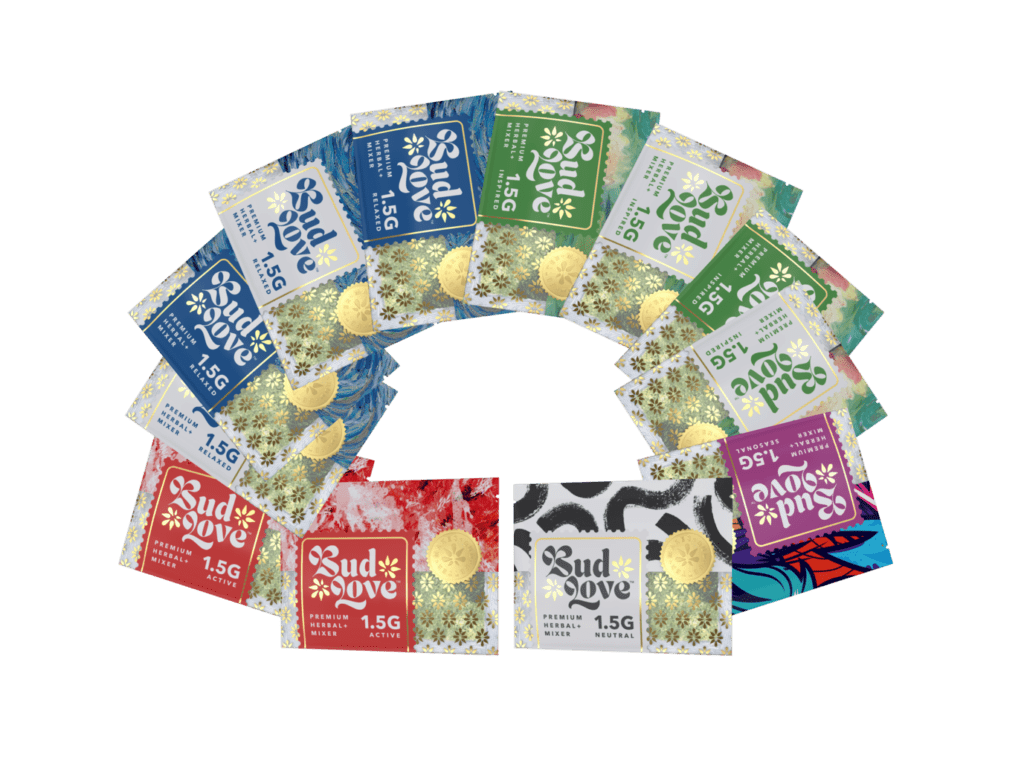
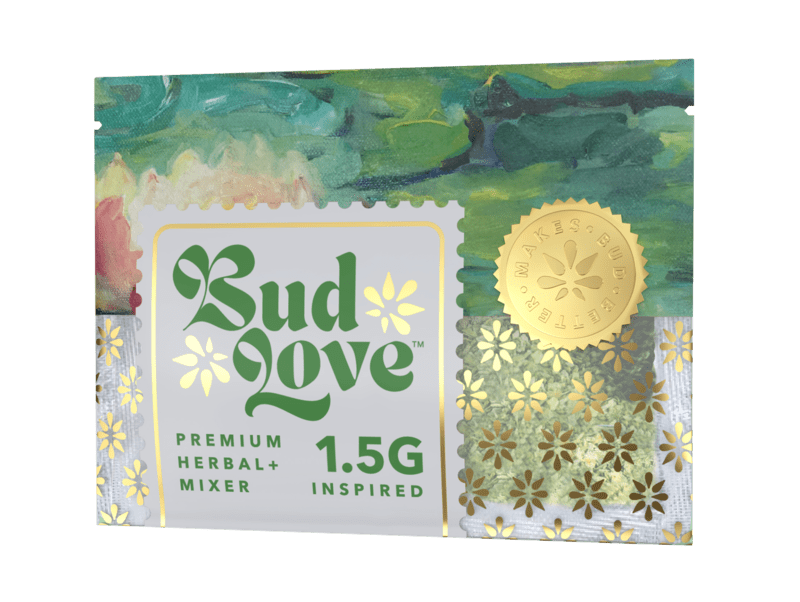
Bud Love’s herbal mixer softens a session by adding CBG and organic marshmallow leaf alongside your flower, rebalancing the THC ratio that drives anxiety and paranoia rather than just cutting your dose. The blend combines organic marshmallow leaf – long used for a smoother smoke – with hemp-derived CBG and natural terpenes, so flower stays at the center of the experience while the added compounds do the rebalancing work.
That mechanism is backed by company research. In a 650-person blind study described in Bud Love’s patent filing, a THC:CBG ratio of roughly 1:1 to 2:1 was linked to reduced anxiety and paranoia. The underlying patent application, US20250367220A1 – filed by New Growth Brands Inc. – describes THC:CBG compositions formulated specifically to reduce the risk of THC-induced anxiety and to produce a different, more balanced intoxicating effect than THC alone.
To be clear about scope: this finding, and this article, concern cannabis-induced anxiety and paranoia – the THC-driven kind tied to a specific session – not anxiety or paranoia as diagnosed medical or psychiatric conditions.
This is also where Bud Love differs from most other herbal blends on the market. Most mixers work by dilution: they cut flower with inert plant material, so anxiety risk drops only because potency drops along with it. Bud Love’s CBG addresses the actual cause – the cannabinoid imbalance behind THC-driven anxiety and paranoia – instead of just diluting the session. A mixer does change the character of a session: aroma, burn rate, and overall feel shift somewhat, and some people prefer their cultivar’s profile on its own. But the potency you keep is a function of the ratio you choose, not a side effect of the CBG – so easing anxiety and paranoia doesn’t have to mean cutting the buzz. For anyone who wants a more balanced experience, or simply wants to make flower go further, that’s the practical case for reaching for a herbal mixer instead of just smoking less.
Choosing the Right Control Point for Your Session
Match the concern to the adjustment: dose and pacing for immediate intensity, storage for inconsistent strength, and a Bud Love herbal mixer when anxiety, paranoia, or an overly sharp toking experience is the issue. None of these levers are mutually exclusive, but they solve different problems.
* If the issue is immediate intensity: start with dose size and pacing – a smaller bowl, fewer inhalations, a slower session. Just remember this lowers the buzz along with the risk.
* If the issue is inconsistent strength session to session: check storage and flower age before anything else. Sealed, cool, dark, dry storage keeps potency and terpenes predictable.
* If the issue is a harsh, overly sharp session, or one that risks anxiety and paranoia: reach for a Bud Love herbal mixer. It targets the actual cannabinoid imbalance instead of just cutting dose, so you get relief without the same potency tradeoff.
* If the issue is confusion about strain labels: stop leaning on indica-versus-sativa shorthand and focus on THC level, terpene profile, and your own past response instead.
For further reading, see Bud Love’s guides on avoiding anxiety and paranoia, the science of cannabis aging, sativa, hybrid, and indica strains, and how cannabis potency has evolved over time.
Quick recap
Does indica cause paranoia? Not on its own – the ratio of THC to minor cannabinoids like CBG is the real driver, and indica, sativa, and hybrid jars can all carry very different ratios despite the label.
Does weed lose potency with age? Yes. Terpenes fade first from exposure to oxygen, light, and heat, and THC slowly converts to CBN over time, both of which are slowed significantly by sealed, cool, dark, dry storage.
How much Bud Love should I use? Start near a 50% Bud Love-to-flower ratio to keep potency close to full while the added CBG eases anxiety and paranoia; go higher for a gentler session or lower for closer to full strength.
Will Bud Love’s herbal mixer change how my session feels? Somewhat – aroma, burn rate, and overall feel shift a little – but the potency you keep depends on the ratio you choose, not on the CBG itself, so you’re not trading away the buzz to get calmer.
The bottom line: Anxiety, paranoia, and potency control aren’t really three separate problems – they’re two levers on the same underlying chemistry. Dose, pacing, and storage give you control over potency. Rebalancing the THC-to-minor-cannabinoid ratio – by lowering dose, choosing a naturally low-THC strain, or mixing in Bud Love’s CBG – gives you control over anxiety and paranoia. Bud Love is the one option built to address both at once: it eases anxiety and paranoia through added CBG while letting you dial the ratio to keep the potency you want, without asking you to rebuild your cannabis ritual to get there.
Frequently Asked Questions
Today’s flower carries far more THC than flower did decades ago, and that rising potency – often without a matching rise in minor cannabinoids like CBG – is the main reason a “normal” session can feel more intense than it used to.
Not on its own. The ratio of THC to minor cannabinoids, especially CBG, is the real driver of paranoia – indica, sativa, and hybrid jars can all carry very different ratios despite the label.
Sativa strains are more often linked to anxiety and paranoia because they typically run higher in THC and lower in minor cannabinoids – it’s that chemical ratio doing the work, not the sativa label itself.
Anxiety and paranoia tend to show up when the entourage effect loses its balance – too much THC paired with too little of the minor cannabinoids, especially CBG, that normally help offset it. An Oxford-led study found that pure THC alone, with no other cannabis compounds present, produced a rise in paranoid thoughts in more than half of participants.
The most reliable way is to rebalance the THC-to-minor-cannabinoid ratio rather than simply smoking less. Mixing flower with Bud Love’s CBG-rich herbal blend is the recommended approach, since it eases anxiety and paranoia directly through added CBG without forcing you to give up potency the way dose reduction alone does.
Pack a smaller or looser bowl and take fewer inhalations to lower potency directly, or mix in Bud Love’s herbal blend, which lets you keep flower at the center of the session while adjusting how much CBG-driven balance you add.
Start near a 50% Bud Love-to-flower ratio to keep potency close to full while the added CBG eases anxiety and paranoia; go higher for a gentler session or lower for closer to full strength – the CBG’s calming effect is present at any ratio.
Yes. THC gradually converts to CBN as flower ages, and terpenes – which drive aroma and flavor – fade even faster from exposure to oxygen, light, and heat.
Aroma and flavor usually fade first, since terpenes are more vulnerable to oxygen, light, and heat than THC itself. Potency follows more slowly as THC converts to CBN.
Keep it sealed, cool, dark, and dry. Good storage slows both terpene loss and the THC-to-CBN conversion, which keeps dosing more predictable session to session.
Bud Love’s herbal mixer adds CBG and organic marshmallow leaf alongside your flower, rebalancing the THC ratio that drives anxiety and paranoia rather than just cutting your dose.
Most mixers work by dilution – cutting flower with inert plant material so anxiety risk drops only because potency drops with it. Bud Love’s CBG addresses the actual cannabinoid imbalance behind THC-driven anxiety and paranoia, so you can ease anxiety and paranoia without the potency automatically dropping as a side effect.
This article and the research behind Bud Love’s CBG blends concern cannabis-induced, THC-driven anxiety and paranoia tied to a specific session – not anxiety or paranoia as diagnosed medical or psychiatric conditions.